
Screed Concrete Explained: A Guide for New Construction Workers
Ask most first-year site workers what “screed” means and you’ll get a shrug, or maybe a half-answer picked up from overhearing the foreman. Nobody really sits you down and explains it, which is odd, because screed concrete is one of those quiet details that decides whether a floor lasts twenty years or starts cracking within twenty months. I’ve seen both, and the difference almost always comes down to whether the crew respected the basics.
This piece is meant to be that sit-down explanation — what screed concrete is, why concrete screeding is worth taking seriously, and how the process actually plays out once you’re standing on the slab with a straightedge in your hands.
So What Is Screed Concrete, Really?
Strip away the jargon and screed concrete is simply a thin top layer, usually a blend of cement and sharp sand, laid over a structural concrete slab to give it a smooth, level surface. It isn’t the load-bearing slab underneath — that’s already done its job by the time the screeding crew shows up. Screed is the finishing step, the layer that flooring, tiles, or carpet will actually sit on.
A useful way to picture it: the base slab is the rough bone structure of the floor, poured for strength rather than precision, and the screed is what smooths that out into something you’d actually want to walk on. Skip it, or rush it, and you’re setting tiles onto an uneven, gritty surface. That’s how you end up with hollow-sounding tiles and floors that creak two years after handover.
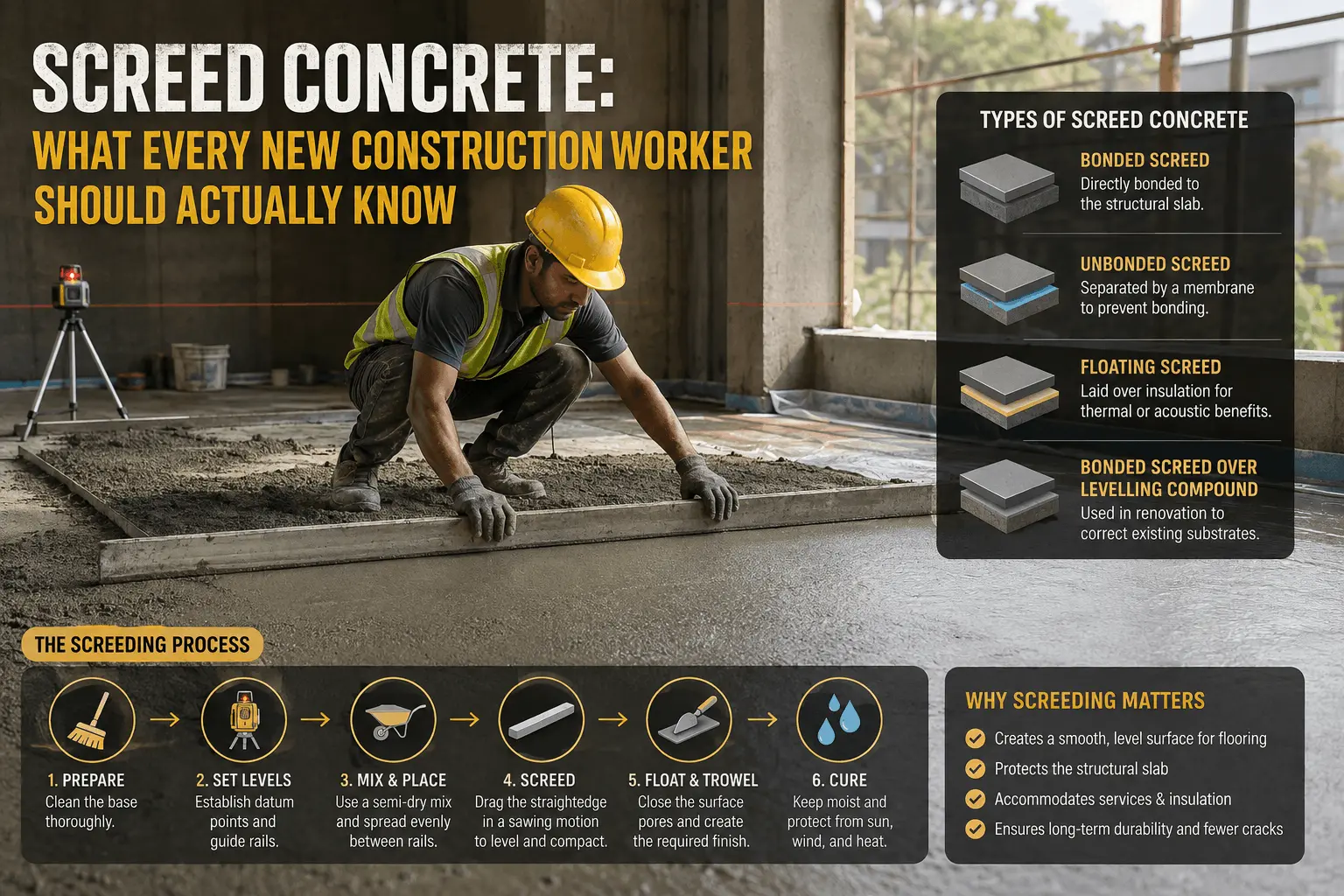
Not all screeds are built the same way, though, and knowing which type you’re dealing with matters more than you’d think:
Bonded screed
Bonded screed goes directly onto the structural slab, usually with a bonding agent to lock it in place. Works well for areas with light to moderate loads, and it’s probably the type you’ll run into most often as a beginner.
Unbonded screed
Separated from the base by a membrane, often polythene sheeting. Used when the slab beneath can’t be trusted to bond properly, whether due to contamination or an uneven pour.
Floating screed
Sits over an insulation layer, which is why you’ll see it paired with underfloor heating systems or wherever acoustic and thermal insulation is required.
Bonded screed over a levelling compound
More common in renovation work, where the existing substrate needs correcting before anything new goes down.
Why Bother Screeding at All?
New workers sometimes write it off as an extra smoothing step, something cosmetic. It isn’t. Screeding does real, functional work.
For one, it corrects a slab that was never meant to be perfectly flat in the first place. Structural pours are judged on strength, not surface precision, so dips and high spots are completely normal at that stage. Screeding is what brings the surface within the tight flatness tolerances that flooring installers actually need.
It also protects the concrete underneath it. A properly laid screed takes the wear from foot traffic, trolleys, and general site activity during construction, sparing the structural slab from surface damage it was never designed to absorb.
There’s a services angle too — underfloor heating pipes, electrical conduits, insulation, all of it often gets buried within or beneath the screed layer. That’s exactly why floating screeds have become so common in modern homes.
And perhaps most importantly, screed quality shows up years later. A screed that was mixed too wet or cured too fast will eventually crack, dust off, or separate from the slab beneath it — and by then, the flooring is already down, which turns a small mistake into an expensive one.
Watching It Happen on Site
Reading about screeding only gets you so far. Here’s roughly how it unfolds once boots are on the ground.
First, the base gets prepared — swept clean, free of oil, dust, and loose debris. If it’s a bonded screed, a bonding slurry usually goes down first to help the two layers grip each other.
Next comes the levels. A laser level or simple string lines help establish datum points, and guide rails (some crews call them screed battens) get set across the area. Don’t underestimate this step — everything about the finished floor’s level depends on how carefully these guides were placed.
Then the actual mixing and placing begins. A typical screed mix runs somewhere between 1:3 and 1:4.5, cement to sharp sand, with just enough water to make it workable. Traditional screed is semi-dry — grab a handful and it should hold its shape, not slump the way wet concrete does.
Once it’s placed between the guide rails, a straightedge is dragged across in a sawing motion to strike off the excess and compact what’s left. This part rewards patience more than muscle; rushing it shows up immediately in an uneven finish.
After that comes floating and trowelling, closing up the surface pores and giving it whatever finish the job calls for — smooth and power-floated, or slightly textured if tiles are going on top.
And then, curing — the step almost everyone underestimates. Screed needs to dry out slowly, shielded from wind, direct sun, and rapid moisture loss for at least the first several days. Rush this part and you’re all but guaranteed cracking somewhere down the line.
Mistakes Worth Learning From Early
A few issues tend to repeat themselves across job sites, no matter the crew:
Too much water in the mix, which leads to shrinkage cracks as it dries out. Curing that’s cut short, especially in hot or windy weather. Poor bonding prep, which you can often catch by tapping the surface and listening for a hollow sound. Getting the thickness wrong — too thin and it’s fragile, too thick without proper reinforcement and it’s asking for trouble. And rushing the trowelling stage, which almost always leaves behind a dusty or uneven finish.
The Takeaway
Screed concrete doesn’t get talked about the way structural framing or foundations do, but it’s the layer you actually feel underfoot every single day in a finished building. If you’re just starting out in construction, understanding what concrete screeding involves – the types, the reasoning behind them, the process – is a small piece of knowledge that pays off constantly. It also teaches something less tangible: patience, and a respect for the fact that some materials simply need time to become what they’re supposed to be.
Next time you walk across a floor that’s dead flat and free of cracks, you’ll know there was a crew somewhere that got the screeding right — and that it probably wasn’t as simple as it looked.