
Concrete Finish Types: A Complete Guide to Finishing Concrete
Walk around any building site for long enough and you start noticing something odd. Concrete isn’t just concrete. One slab is polished until it practically reflects light, the next feels gritty under your boots, and then there’s the one that’s been dressed up to pass for slate or timber decking. None of that is an accident. It’s all down to the concrete finish.
And a concrete finish is never just decoration. It decides whether a surface is safe to walk on when it’s raining, how many years it lasts before it starts breaking down, and how much work you’ll be putting into maintaining it later. Pick the wrong finish for a driveway, or a warehouse floor, and you’ll be dealing with that decision long after the truck’s gone home.
So here’s a rundown of what concrete finish actually means, why it matters more than people assume, and the types of concrete finish you’re most likely to run into on a job.
What Is a Concrete Finish, Exactly?
At its core, a concrete finish is the surface treatment that goes on after the slab has been poured, levelled, and compacted. It happens right near the end — once the concrete has firmed up a little, but before it’s hardened for good.
Finishers reach for bull floats, hand trowels, sometimes brooms, occasionally stamps, depending on what look they’re chasing. Smooth, textured, somewhere in between — the tools decide the outcome almost as much as the technique does.
Timing is the tricky part. Too early, and the surface won’t hold its shape. Too late, and the concrete’s already stiffened past the point of being workable. Anyone who’s spent real time finishing concrete will tell you it comes down to feel — watching the bleed water, testing the surface underfoot, knowing the window before it closes.
Why Bother With Different Finishes at All?
Fair question. Isn’t concrete just concrete once it’s dry?
Not really. A rougher finish grips better underfoot — handy around pools, ramps, anywhere water tends to sit. A smooth finish looks sharper and wipes clean easier, which is exactly why factories and garages lean toward it. Decorative finishes exist for a simpler reason: nobody’s excited by a plain grey slab, and contractors have known that for years.
There’s a durability angle too, not just looks. A badly finished surface dusts, cracks, scales — sometimes within a couple of winters. Get the finish right and you’re looking at decades of life out of the slab instead of years.
Common Types of Concrete Finish
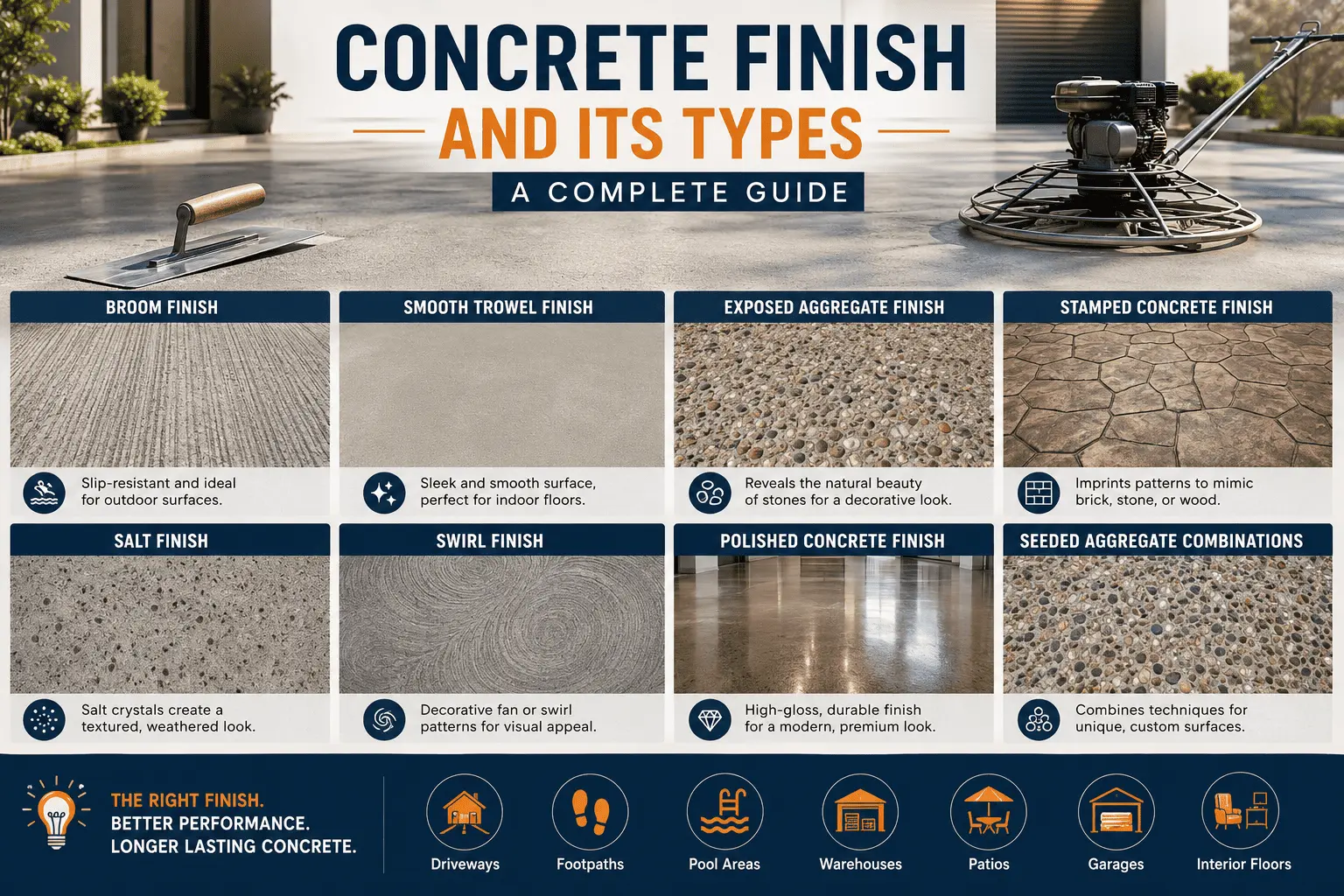
Broom Finish
Odds are you’ve walked across this one today without giving it a second thought. A stiff broom gets dragged over the still-soft surface, leaving behind fine ridges — and those ridges are the whole point. They’re what keeps your shoes from sliding on a wet path or driveway.
Push the broom harder or at a different angle and the texture changes. Pool surrounds usually get the heavier hand, for reasons that should be obvious.
Smooth Trowel Finish
The glassy, almost mirror-like look that comes from repeated passes with a steel trowel — power floats do the heavy lifting on bigger jobs. Warehouses, garages, basements: anywhere a flat, dense surface counts for more than traction.
Worth knowing before you fall in love with the look: smooth trowel finishes turn slippery fast once wet. That’s why you don’t see them much outdoors unless there’s a sealer doing extra work underneath.
Exposed Aggregate Finish
Here the stones don’t get buried — the top layer of cement paste gets washed or brushed away instead, exposing whatever’s sitting underneath. Pebbles, crushed rock, coloured gravel if someone wants a bit of flair.
Driveways and patios go for this one a lot. It looks natural, grips reasonably well without a broom finish, and honestly just photographs better than plain grey concrete. The catch is it takes a more careful hand to install properly.
Stamped Concrete Finish
Patterns get pressed into the surface before it fully sets, so what you end up with can pass for brick, slate, cobblestone, even timber — at least from a few feet away. Colour hardeners and release agents usually go down first to make the illusion hold up.
The appeal is obvious: the look of expensive paving without the expensive paving bill. Patios and pool decks are where this shows up most.
Salt Finish
An older technique, this one. Rock salt gets pressed into the wet concrete, and once the slab cures, the salt washes out — leaving small pits scattered across the surface. Slightly weathered, a bit rustic, not for everyone.
Mostly seen in warmer climates, outdoors, where the texture helps with grip and the worn-in look actually suits the setting rather than fighting it.
Swirl Finish
Take a trowel finish and add a twist — literally. Instead of flat, straight passes, the trowel moves in arcs and fans, leaving a decorative pattern behind. Somewhere between smooth and heavily textured.
Garden paths, patios, that sort of thing. It adds visual interest without going all-in on texture the way a broom finish does.
Polished Concrete Finish
Diamond pads, progressively finer grits, ground down until the surface shines almost like polished stone. Durable, low-maintenance, and it’s become something of a signature look in retail fitouts and showrooms — homeowners chasing an industrial aesthetic like it too.
There’s a practical bonus most people don’t think about: polished floors bounce light around a room, which can genuinely cut lighting costs in bigger spaces.
Seeded Aggregate Combinations
Some jobs blend more than one technique — decorative stone gets seeded into the surface, then partially exposed, producing a finish that’s genuinely hard to copy with any single method. It costs more, takes longer, and the result is basically one-of-a-kind because of it.
So Which Finish Should You Actually Pick?
There’s no single right answer. It depends entirely on where the concrete’s going and what it needs to survive.
For driveways, footpaths, pool areas — go broom or exposed aggregate. Grip beats gloss in those spots, every time. Indoor commercial floors usually lean smooth trowel or polished instead. Patios and outdoor entertaining areas are where stamped, salt, or swirl finishes get to show off a bit.
Final Thoughts
It’s tempting to treat finishing concrete as a minor last step, but it’s arguably one of the bigger decisions in the whole project. A broom finish is the difference between staying upright on a wet path and not. A polished floor is what makes a showroom look like money. A stamped patio can fool guests into thinking it’s real stone — until they crouch down and touch it.
Talk to your contractor about the finish before the pour, not after. Stamping especially needs to be planned in from the start. Trying to retrofit a different look once the slab’s down is rarely cheap, and rarely simple either.