
What Is Irrigation? Types and Methods, Explained Properly
You’ve probably seen it without really thinking about it. A pipe running along the edge of a paddock. A sprinkler throwing water in slow circles over rows of crops at dusk. That’s irrigation. Most people drive past it their whole lives without ever asking what it is, or why farmers bother with it instead of just waiting for rain.
Here’s the short version: rain doesn’t show up on schedule. Irrigation exists to fix that.
What Is Irrigation?
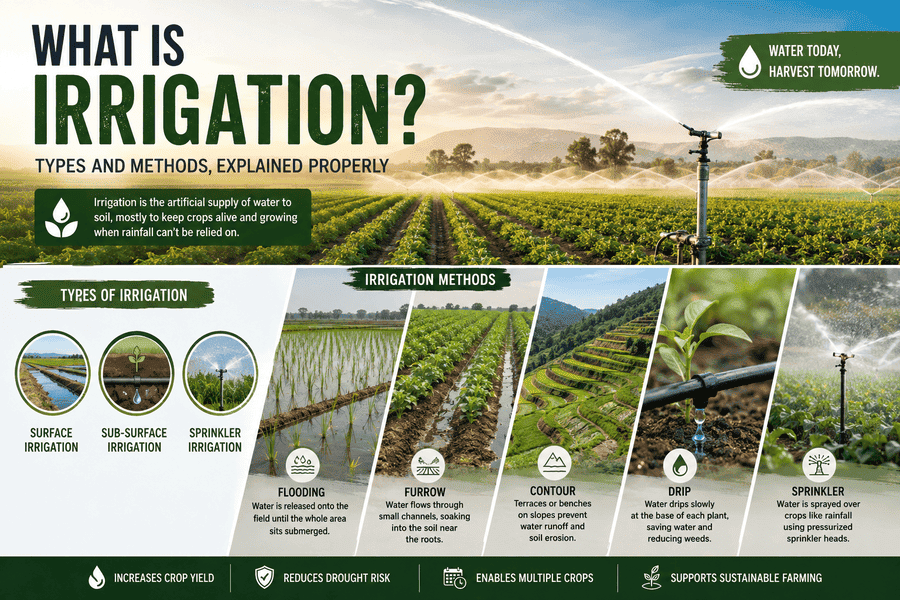
So what is irrigation, in plain terms? It’s the artificial supply of water to soil, mostly to keep crops alive and growing when rainfall can’t be relied on.
And it genuinely can’t be relied on. Some seasons you get a week of solid rain right when the crop needed a slow trickle instead. Other seasons nothing falls at all, and the ground just cracks.
Farmers who wait around for rain are gambling. Irrigation takes that gamble off the table. Water goes where it’s needed, when it’s needed, in roughly the amount that’s needed.
That last part matters more than people think. Too little water and the plant stalls. Too much and you get root rot, nutrients washing away, sometimes a fungal problem showing up a fortnight later out of nowhere. A well-run irrigation system is really just about hitting that middle ground, over and over, season after season, without much drama.
Why It’s Not Optional Anymore
Water sits right alongside sunlight as something no plant can skip. It’s also the one thing farmers have the least control over naturally. That’s basically the whole reason irrigation went from “nice to have” to “you’re not farming seriously without it.”
A few reasons this matters so much:
- Rainfall is inconsistent, both in timing and total volume, and plenty of regions simply don’t get enough of it in the first place.
- Crops under a proper irrigation system usually out-yield rain-fed ones, sometimes by a lot.
- When drought hits, irrigation is often the only thing keeping a season from being a total write-off.
- Because planting isn’t tied to whenever rain decides to show up, farmers can often squeeze in more than one crop cycle a year.
Put it all together and irrigation stops looking like a bonus. It’s closer to the backbone of modern farming.
Types of Irrigation
When someone asks about the types of irrigation, they’re really asking one question: how does water get from its source to the plant? Most irrigation systems fall into three broad categories, and each one fits a different combination of land, crop, and budget.
Surface irrigation
Surface irrigation is the oldest of the bunch, and still the most common globally. Water is released and simply flows across the field, gravity doing all the work. It needs a bit of a slope to work properly, otherwise the water just pools instead of spreading. No pumps, no pressurised pipework, nothing fancy. That’s exactly why it’s the cheapest type of irrigation system to set up, and it explains a lot of its popularity in places where farmers can’t stretch to expensive infrastructure.
Sub-surface irrigation
Sub-surface irrigation flips the approach. It gets water down to the roots directly, bypassing the surface almost entirely. Skipping that open-air trip cuts down on evaporation in a big way. Sometimes it happens naturally, through a water table sitting close enough for roots to tap into on their own. Other times it’s built deliberately, using buried pipes riddled with tiny holes that let water seep out right near the root zone. Drip irrigation belongs in this family too, more on that shortly.
Sprinkler irrigation
Sprinkler irrigation is the more modern, mechanised cousin of surface methods. Pumps push water through a network of pipes and out through sprinkler heads, so it lands over the crop like a light, artificial rain shower. It works well on uneven land, erosion-prone soil, or ground where the topsoil is too shallow to hold flooded water without causing damage. The extra equipment costs more, sure, but it buys a lot more control over exactly where the water lands.
These three types of irrigation systems cover most of what you’ll come across, whether you’re looking at a backyard vegetable patch or a few thousand hectares of broadacre cropping.
Irrigation Methods, One By One
Types give you the big picture. Irrigation methods are where the actual decisions get made on the ground.
Flooding
Exactly what it sounds like. Water is released onto the field until the whole area sits submerged. Rice is the classic crop here, since it’s happy sitting in standing water for weeks. There’s a controlled version, where the land’s been prepped in advance with small channels so water spreads evenly. And there’s the uncontrolled or “wild” version, where no prep happens at all and the water just goes wherever gravity sends it. Less efficient, obviously, but it happens anyway near rivers during heavy rain when there’s no time for precision.
Furrow
Instead of flooding the whole field, narrow channels get dug along the slope and water is sent down those instead of everywhere at once. It soaks sideways and downward toward the roots rather than spreading across the entire surface. The wetted area ends up somewhere around 30 to 50 percent smaller than flooding, which adds up to real water saved. Crops like cotton, potatoes, sugarcane and tobacco are usually grown this way.
Contour
On sloped or hilly land, gravity works against you rather than for you. So the land gets reshaped into terraces or benches, each one held in place by a small bund that stops water rushing downhill and taking the topsoil with it. More labour to set up, no question. But for hillside farming, there’s often no better option if erosion is a real risk.
Drip
Also called trickle irrigation, and probably the most water-efficient method of irrigation in use today. Tiny emitters release water drop by drop right at the base of each plant, somewhere between two and ten litres an hour, and capillary action carries that moisture out through the surrounding soil. Because so little of it is ever exposed to sun or open air, evaporation loss stays low. It also happens to starve weeds growing between the rows, since they’re not getting a share of the water either. Costs more upfront than most methods, but plenty of growers find the water savings and yield improvement pay that back within a couple of seasons.
Sprinkler
Same principle as sprinkler irrigation above, just at the ground level of decision-making. Pressurised pipes feed rotating or fixed heads that spray water over the crop in a pattern meant to copy light rainfall. Works across a much wider range of soil types and terrain than surface methods ever could, which is really the whole selling point.
Picking the Right One
There’s no single “correct” method, whatever some guides might tell you. It comes down to the crop being grown, the slope of the land, the soil type, how much water is actually available, and what the budget allows.
A rice farmer on flat, low-lying ground will almost always stick with flooding, because it’s cheap and it works for that crop. A vineyard on a slope with limited water access will lean toward drip irrigation nearly every time, because efficiency ends up mattering more than the upfront cost. Neither is the “better” choice in general terms. It’s about matching the method to whatever conditions are actually in front of you.
Conclusion
Irrigation isn’t some minor add-on to farming, tucked away in the background. It’s a big part of why agriculture scaled up the way it has, and stopped being such a gamble on the weather.
Getting a handle on the different irrigation types, surface, sub-surface, sprinkler, and knowing which method suits which situation, is worth understanding whether you’re studying civil or agricultural engineering, running a farm, or just curious about where food actually comes from before it hits a shelf.
Water’s only going to get scarcer and more expensive from here. That’s probably going to push more farms toward efficient methods of irrigation like drip and sprinkler, even in places that have always defaulted to flooding out of habit. The technology keeps shifting. The goal underneath it hasn’t, though: get water to the roots that need it, and try not to waste what you don’t have to.