
Mortar vs Concrete vs Cement: What’s the Real Difference?
Ask ten people on a job site what cement is, and half of them will point at a bag of concrete mix. It happens all the time. These three words get thrown around like they’re one thing, but they’re not, and mixing them up can actually cause real problems on a build.
So let’s sort it out properly.
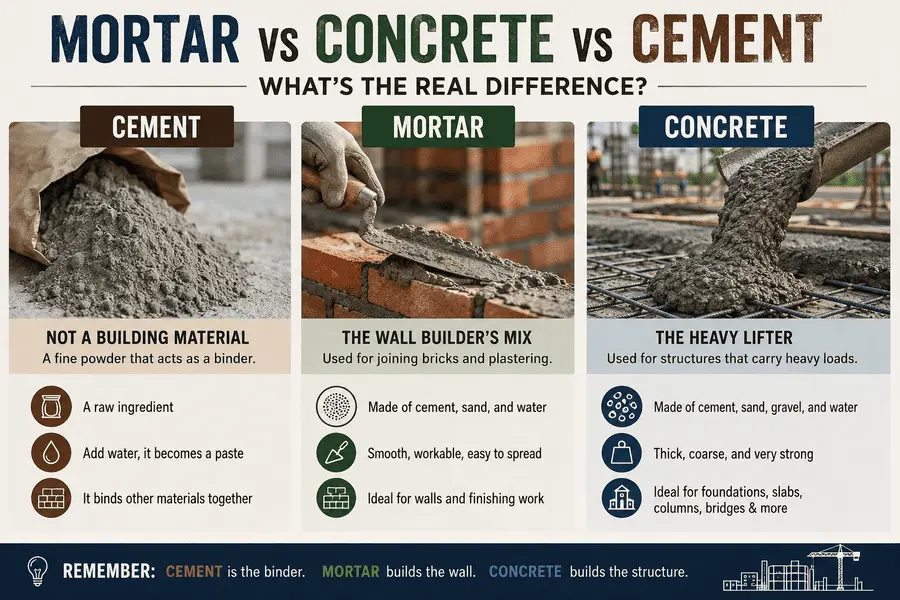
Cement is Not a Building Material
This surprises a lot of students at first. Cement, by itself, doesn’t build anything.
It’s a fine grey powder made by grinding limestone and clay, then burning it at extremely high heat. That’s it. Nothing you’d call a “material” in the finished-product sense.
- It’s a binder, nothing more.
- Add water, and it turns into a paste.
- That paste hardens, and it’s what holds everything else together.
Picture cement as glue in a woodworking project. Glue alone doesn’t make a table. It needs wood to hold together first.
Mortar: The Wall Builder’s Mix
Mix cement with sand and water, and now you’ve got mortar.
Bricklayers use this stuff every day. Spread a layer between bricks, press the next one down, and it sets hard enough to hold a wall up for decades. It’s also what goes on walls before plastering.
A few things worth knowing about mortar:
- No gravel or crushed stone in it, ever.
- Smoother and thinner than concrete, which is exactly why it spreads easily with a trowel.
- Cement + sand + water, roughly in that order.
Concrete: The Heavy Lifter
Now throw gravel or crushed stone into that same mix, and you’ve got concrete.
That extra ingredient changes everything. Concrete carries weight in a way mortar simply can’t. Foundations, slabs, columns, bridges, driveways, all of it relies on concrete’s strength.
- Cement + sand + gravel + water.
- Far tougher than mortar once cured.
- Built for load, not for finishing touches.
Mortar and Concrete, Side by Side
| Point | Mortar | Concrete |
| Made from | Cement, sand, water | Cement, sand, gravel, water |
| Strength | Moderate | High |
| Typical use | Joining bricks, plastering | Foundations, slabs, structural work |
| Feel | Smooth, workable | Thick, coarse |
Cement vs Mortar in One Breath
Here’s the confusion cleared up in two lines:
- Cement is a single raw ingredient.
- Mortar is what you get after mixing that ingredient with sand and water.
Cement can’t hold a brick wall together on its own. It needs help first.
Why Any of This Actually Matters
Swap these materials in the wrong spot and you’re asking for trouble.
Try laying a foundation with mortar instead of concrete, and you’ll end up with a structure that can’t handle the load above it. Try plastering a wall with concrete, and the gravel will make the surface lumpy and impossible to smooth out.
Getting this right isn’t just textbook knowledge. It saves money, prevents structural failures, and honestly, it’s the kind of basic understanding that separates a rushed job from a properly built one.
FAQ’s
Q. Can mortar replace concrete?
No. Mortar doesn’t have the strength to handle structural loads.
Q. Is cement basically concrete?
No, cement is just one ingredient that goes into making concrete.
Q. Between mortar and concrete, which is stronger?
Concrete, mainly because of the coarse aggregate it contains.
The Short Version
- Cement: the binding powder that starts it all.
- Mortar: cement, sand, and water, made for joining and finishing.
- Concrete: cement, sand, gravel, and water, built to carry weight.
Keep that chain in your head, and you won’t mix these three up again.