
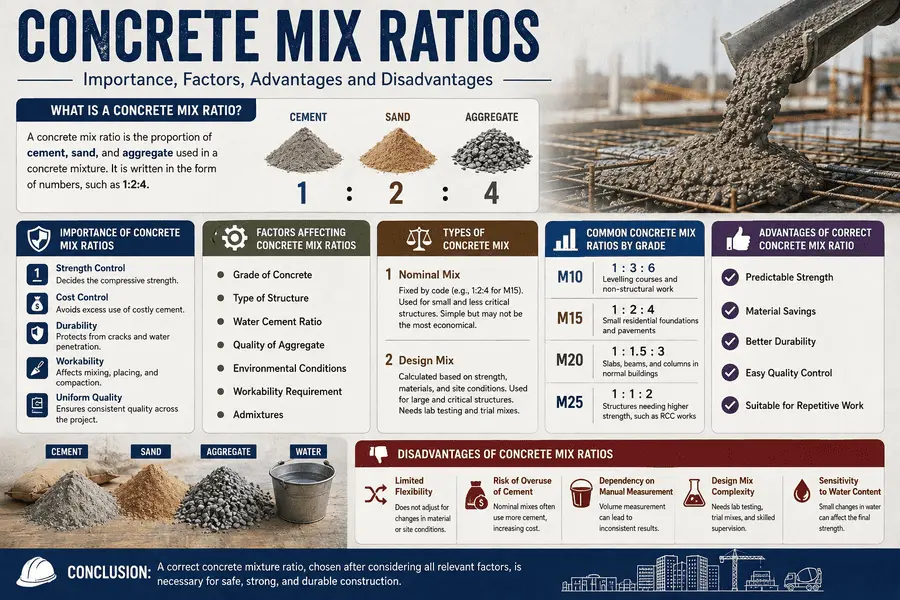
Concrete Mix Ratios: Importance, Factors, Advantages and Disadvantages
Concrete is a mixture of cement, sand, aggregate, and water. The proportion of these materials is called the concrete mix ratio. This ratio decides the strength, workability, and durability of concrete. A correct concrete mixture ratio is the base of any strong construction work.
What is a Concrete Mix Ratio
A concrete mix ratio is the proportion of cement, sand, and aggregate used in a concrete mixture. It is written in the form of numbers, such as 1:2:4. Here, 1 part is cement, 2 parts are sand, and 4 parts are aggregate. The sand and cement mix ratio is a major part of this proportion, since it controls the paste that binds the aggregate together.
Concrete mix ratios are decided based on the required strength of the structure. A higher proportion of cement gives higher strength. A higher proportion of aggregate reduces cost but also reduces strength.
Importance of Concrete Mix Ratios
The concrete mix ratio is important for the following reasons.
Strength Control: The ratio decides the compressive strength of concrete. Wrong proportions lead to weak structures.
Cost Control: Cement is the costliest material in concrete mixtures. A correct ratio avoids excess use of cement.
Durability: A balanced ratio protects concrete from cracks, shrinkage, and water penetration.
Workability: The ratio affects how easily concrete can be mixed, placed, and compacted during concrete compaction.
Uniform Quality: A fixed ratio gives consistent quality across a project, especially in large scale construction.
Factors Affecting Concrete Mix Ratios
Several factors affect the selection of a concrete mix ratio.
1. Grade of Concrete: Every grade, such as M15, M20, or M25, has a fixed mix ratio. Higher grades need more cement.
2. Type of Structure: Foundations, columns, slabs, and roads all need different strength levels. This changes the required ratio.
3. Water Cement Ratio: The amount of water added to cement affects strength directly. Too much water weakens concrete.
4. Quality of Aggregate: Clean, well graded aggregate needs less cement paste. Poor quality aggregate needs more cement.
5. Environmental Conditions: Concrete exposed to sulphates, chlorides, or extreme weather needs adjusted ratios for durability.
6. Workability Requirement: Concrete for pumping or for congested reinforcement needs a different ratio than concrete for mass pouring.
7. Admixtures: Chemical admixtures, such as plasticizers, can change the water content needed, which affects the final ratio.
Types of Concrete Mix
There are two main types of concrete mix based on how the ratio is decided.
1. Nominal Mix
In this type, the ratio of cement, sand, and aggregate is fixed by code, such as 1:2:4 for M15 grade. It is used for small and less critical structures. It does not require detailed calculation, but it may not give the most economical use of materials.
2. Design Mix
In this type, the ratio is calculated based on the required strength, materials available, and site conditions. It is used for large and critical structures such as bridges and high rise buildings. It gives better control over strength and durability, but it needs laboratory testing and trial mixes.
Common Concrete Mix Ratios by Grade
M10: 1:3:6 ratio, used for leveling courses and non-structural work.
M15: 1:2:4 ratio, used for small residential foundations and pavements.
M20: 1:1.5:3 ratio, used for slabs, beams, and columns in normal buildings.
M25: 1:1:2 ratio, used for structures needing higher strength, such as RCC works.
These ratios are common for nominal mix concrete. For design mix concrete, the ratio changes based on project specific testing.
Advantages of Using a Correct Concrete Mix Ratio
Predictable Strength: The final strength of concrete can be estimated in advance.
Material Savings: A correct ratio avoids wastage of cement and other materials.
Better Durability: Structures last longer when the mix ratio is followed correctly.
Easy Quality Control: Site engineers can check and control quality by comparing the mix with the fixed ratio.
Suitable for Repetitive Work: Nominal mixes with a fixed ratio are easy to use for standard structures.
Disadvantages of Concrete Mix Ratios
Limited Flexibility: A fixed nominal mix ratio does not adjust for changes in aggregate quality or site conditions.
Risk of Overuse of Cement: Nominal mixes often use more cement than needed, increasing cost.
Dependency on Manual Measurement: In small sites, mix ratios are often measured by volume, which can lead to errors.
Design Mix Complexity: Design mix ratios need laboratory testing, trial mixes, and skilled supervision, which increases time and cost.
Sensitivity to Water Content: Even a small change in water quantity can affect the final strength, despite a correct solid material ratio.
Conclusion
Concrete mix ratios control the strength, cost, and durability of any concrete structure. Understanding the sand and cement mix ratio, along with aggregate proportion, helps in selecting the right type of concrete mix for a project. Nominal mix ratios work well for small structures, while design mix ratios are needed for large and critical structures. A correct concrete mixture ratio, chosen after considering all relevant factors, is necessary for safe and durable construction.