
Monolithic Slab vs Floating Slab: What’s the Difference?
A slab might look like a simple flat surface, but the way it’s built underneath makes a real difference to how a structure performs over time. Two common approaches, monolithic slab and floating slab, get compared a lot in residential and small commercial builds, and picking the wrong one for the site can cause problems years down the line.
What Is a Monolithic Slab Foundation?
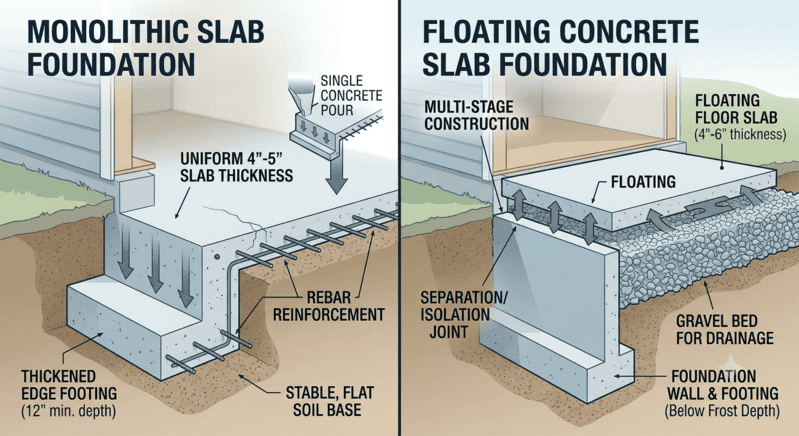
A monolithic slab foundation is exactly what the name suggests, one continuous concrete pour that combines the footing and the floor slab into a single piece. Instead of pouring a footer separately and building the slab on top of it later, the edges of the slab are thickened where the load-bearing walls will sit, while the rest of the slab stays around 4 to 5 inches thick. Everything goes down at once.
This approach tends to be quick and relatively cheap, since there’s only one pour and less labour involved compared to staged construction. It works best on flat, evenly compacted ground. Push a monolithic slab onto uneven or poorly compacted soil and you’re looking at cracking around the edges and load-bearing points down the track, since the slab has no flexibility to move with the ground beneath it.
What Is a Floating Concrete Slab Foundation?
A floating slab, sometimes confusingly also called a monolithic slab because it’s also poured in one go, works differently in practice. It sits on the ground without being physically anchored to a deep footing, more like a raft resting on top of the soil than a structure locked into it. This makes it common for garages, sheds, home additions, and other lighter structures that don’t need a heavy foundation system underneath them.
Building one starts with excavating and levelling the site, then laying a gravel base underneath for drainage, since trapped water is the main threat to any slab sitting close to grade. Reinforcement bars go in next according to the slab’s size and load requirements, then the concrete gets poured and compacted, usually over 2 to 3 days of curing before it’s ready for use.
Monolithic vs Floating Slab: Key Differences
The biggest difference comes down to where each one performs best. Monolithic slabs suit flat, well-compacted sites and hold up better against horizontal forces like earthquakes, which makes them a common choice in warmer, more stable climates. Floating slabs handle shifting or moisture-heavy ground far better, since the slab isn’t rigidly tied to a foundation that could crack under movement, and they’re a common choice in colder regions where frost heave is a real concern.
Cost also splits the two apart. Monolithic slabs are cheaper upfront thanks to the single pour, while floating slabs cost more due to the excavation and gravel work involved, though that cost often buys better resistance to ground movement over time.
Thickness differs too. Monolithic slab foundations typically run about 4 inches thick with a footing extending roughly 12 inches down, while floating slabs vary between 4 and 6 inches with a thicker perimeter beam.
Which One Should You Choose?
Neither type wins outright. A monolithic slab makes sense for a house on flat, stable ground where speed and cost matter. A floating slab makes more sense for a shed, garage, or addition sitting on soil that shifts with moisture or freezing. The right call really depends on soil conditions, climate, and what the structure above actually needs to carry, which is exactly the kind of thing worth checking with a local engineer before committing either way.