
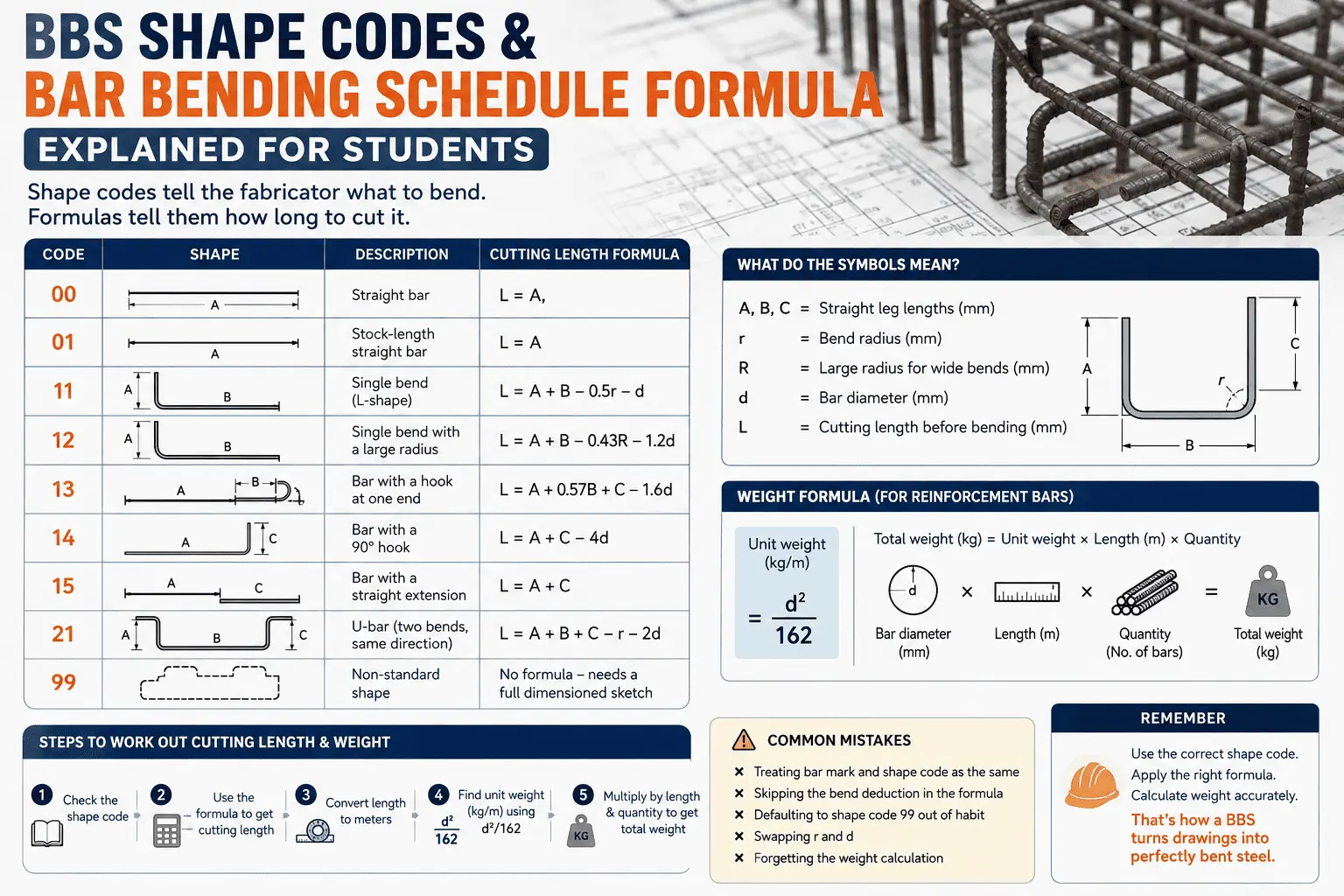
BBS Shape Codes and the Bar Bending Schedule Formula
Open a bar bending schedule for the first time and it reads like nonsense — bar marks, diameters, and then a random two-digit number sitting off to the side with no explanation. That number is the shape code, and next to it is a formula doing the actual math. Between the two, they tell a fabricator exactly what to bend and exactly how long to cut it before bending it. Get comfortable with a handful of each and a BBS stops being a wall of numbers.
What a BBS Actually Is
BBS stands for Bar Bending Schedule — the table listing every reinforcement bar in a structure: mark, diameter, shape, cutting length, quantity. A structural drawing shows where bars go. The BBS is what the fabrication yard actually works from, because nobody’s bending steel by eye on site with a tape measure. Each row covers one bar mark, and two columns do the heavy lifting: the shape code, and the bar bending schedule formula used to work out that bar’s cutting length.
Why This Is Worth Learning Properly
Because a wrong shape code or a botched formula isn’t a small error. Fabricators program bending machines straight off this data, so a mistake here means the wrong bend, wasted steel, and a bar that turns up on site and doesn’t fit the cage. Nobody’s thrilled about re-cutting rebar two days before a pour. There’s also a selfish reason to learn it: reading shape codes and cutting-length formulas is the fastest way to start reading a structural drawing the way a site engineer does, instead of the way a first-year student does.
Where the Codes and Formulas Come From
Neither one gets invented on the spot. They follow a published standard, which is the entire point — a code means the same bend whether the schedule was drawn up in London or Chennai. Most people work from BS 8666, the British Standard covering scheduling, dimensioning, bending, and cutting of reinforcement, last revised as BS 8666:2020. It runs from shape code 00 to 99, and every standard shape comes paired with its own bar bending schedule formula, built from the bar’s leg dimensions — labeled A, B, C, and so on — plus its diameter and the radius it’s bent around.
The Shape Codes and Formulas You’ll Actually Use
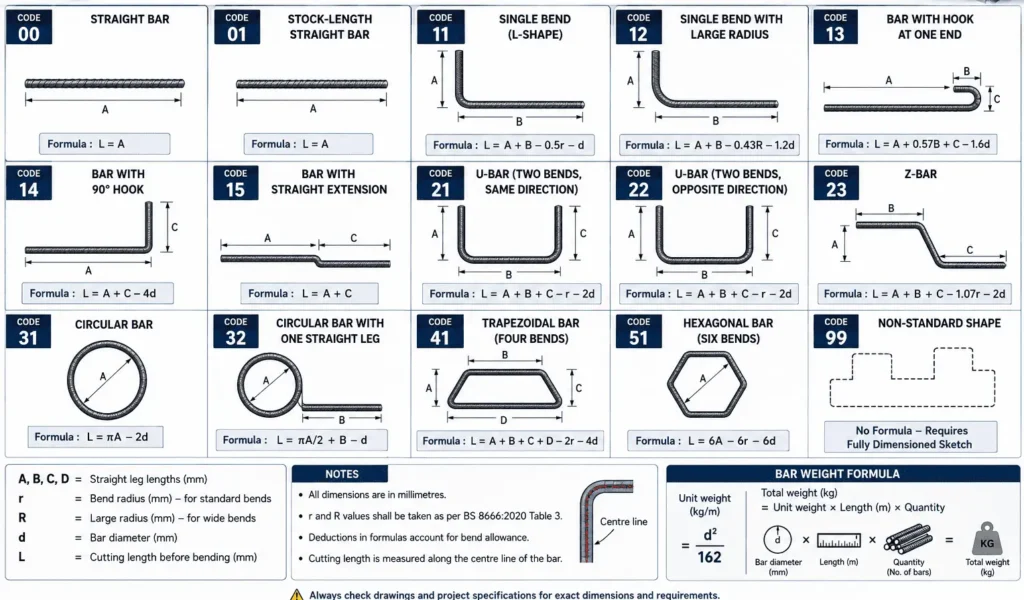
Nobody has all 99 memorized, and most engineers never need to. A small set covers nearly everything you’ll run into on a typical job:
| Code | Shape | Cutting Length Formula |
| 00 | Straight bar | L = A |
| 01 | Stock-length straight bar | L = A |
| 11 | Single bend (L-shape) | L = A + B − 0.5r − d |
| 12 | Single bend with a large radius | L = A + B − 0.43R − 1.2d |
| 13 | Bar with a hook at one end | L = A + 0.57B + C − 1.6d |
| 14 | Bar with a 90° hook | L = A + C − 4d |
| 15 | Bar with a straight extension | L = A + C |
| 21 | U-bar (two bends, same direction) | L = A + B + C − r − 2d |
| 99 | Non-standard shape | No formula — needs a full dimensioned sketch |
In each formula, A, B, C are the bar’s straight leg lengths, r is the bend radius, R is a larger radius used for wide bends, and d is the bar diameter. Every one of those deductions exists for the same reason: bending steel around a radius stretches the outside of the bend and compresses the inside, so a bar’s true cutting length is always a bit shorter than what you’d get from just adding up its straight legs.
Working a Bar Bending Schedule Formula by Hand
Take a shape code 21 bar — a U-bar, two bends in the same direction, the shape you’d recognize on any stirrup — with a 12 mm diameter and dimensions A = 400 mm, B = 250 mm, C = 400 mm. The formula from the table is:
L = A + B + C − r − 2d
r and d both come from the standard’s minimum radius table for a 12 mm bar. Plug everything in, subtract the deduction, and that’s the exact straight length to cut before bending. Skip that step and just add A + B + C, and the finished bar comes out too long — every time, no exceptions.
Don’t Forget the Weight Formula
A cutting-length formula gets you the length. Most schedules also need the weight, since steel is bought and billed by weight, not length. The standard unit weight formula for reinforcement bars is:
Unit weight (kg/m) = d² ÷ 162
where d is the bar diameter in millimeters. Multiply that by the bar’s cutting length in meters, then by the number of bars, and you’ve got the total steel weight for that bar mark. Add up every row and that’s the tonnage going on the order sheet.
Where Students Usually Trip Up
Treating the bar mark and the shape code as the same thing — they’re two different columns doing two different jobs.
Skipping the bend deduction in the formula and just summing the leg lengths.
Defaulting to shape code 99 out of habit instead of checking whether a standard code already covers it.
Swapping r and d — the bend radius and the bar diameter are pulled from two completely different tables.
Forgetting the weight formula entirely and handing over a schedule with lengths but no tonnage.
The Takeaway
You don’t need all 99 shape codes or every formula variant memorized to be useful in a drawing office or on site — eight or ten codes, the general logic behind the deductions, and the weight formula will cover most of what lands on your desk. Next time you’re handed a BBS, check the shape code first, run the formula by hand once to be sure, and the rest of the schedule starts making a lot more sense.
FAQs
What’s the difference between a bar mark and a shape code?
A bar mark is just a label — 101, C1, whatever the drafter chose — for one specific group of bars in the schedule. The shape code is the standardized number that tells the fabricator what shape that group gets bent into, and which formula to use for its cutting length. Plenty of different bar marks end up sharing the same shape code, since lots of bars in a structure are bent the same way even if they’re different lengths.
Is there one bar bending schedule formula that works for every shape?
No, and that trips people up early on. Each shape code has its own formula, because a straight bar, an L-bar, and a U-bar all lose a different amount of length to bending. That’s really the whole reason shape codes exist — the code tells you which formula to reach for.
Is BS 8666 used outside the UK?
It is, quite a lot actually. You’ll see BS 8666 shape codes and formulas used across the Middle East, South Asia, and other regions with UK-influenced construction practices, sometimes running alongside a local standard and sometimes replacing it entirely.
What does shape code 99 mean on a BBS?
It’s the catch-all for anything that doesn’t fit the standard 00-98 codes. There’s no formula for it, so whoever writes the schedule has to include a full dimensioned sketch instead — the fabricator can’t just plug numbers into an equation like they would for the standard shapes.
Why does the cutting length formula subtract a deduction?
Because bending steel isn’t free length-wise. The outer edge of a bend stretches and the inner edge compresses, so a bar’s true cutting length ends up shorter than what you’d get from just adding up its legs. The deduction built into each formula corrects for that so the finished bend matches the drawing.
How do you work out the weight of steel from a BBS?
Once you’ve got the cutting length from the shape code’s formula, weight is a second, separate calculation: unit weight in kg/m equals the bar’s diameter squared, divided by 162. Multiply that by length and quantity, and you’ve got the tonnage for that bar mark.