
Pile Foundations Explained: Types, Uses & How They Work
Introduction
Some ground just can’t hold a building on its own. Soft clay, loose fill, a water table that never drops far enough — put a heavy structure on top and it settles, cracks, or worse. Pile foundations solve that by skipping the weak stuff entirely and sending the load down to soil or rock that can actually take the weight.
What Is a Pile Foundation?
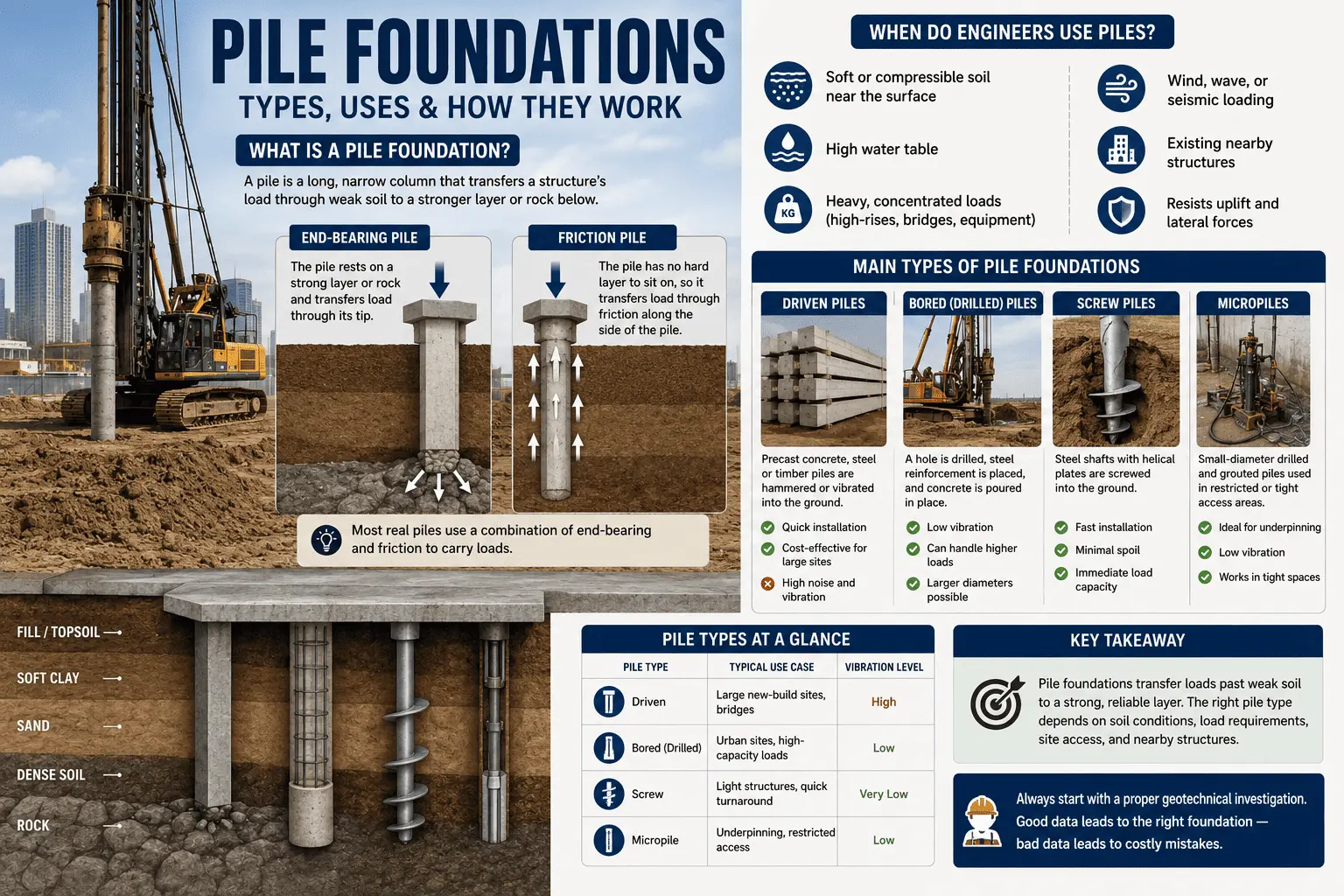
Strip away the jargon and a pile is just a long, narrow column, driven or drilled deep into the ground, that carries a structure’s load past the soft upper layers to something more solid underneath. Compare that to a shallow foundation, which spreads weight across the surface like a snowshoe. A pile does the opposite — it goes down until it finds ground worth standing on.
There are two ways a pile actually does its job. An end-bearing pile sits on rock or a dense stratum and pushes load straight through its tip, the same way a table leg pushes down onto a floor. A friction pile has no hard layer to land on, so it grips the surrounding soil along its entire length instead, spreading the load through friction between the pile surface and the earth around it. Most real piles use a bit of both.
When Do Engineers Reach for Piles?
Nobody specifies piling because it’s fun. It costs more than a shallow footing and takes longer to install, so engineers only pull it out when the site gives them no better option. A few situations that push the decision that way:
Soft or compressible soil near the surface. Clay, peat, loose fill — anything that would settle unevenly under real load.
A high water table. Groundwater turns excavation into a mess and makes shallow footings unreliable.
Heavy, concentrated loads. Think high-rises, bridge piers, industrial equipment — structures that funnel enormous force through a small footprint.
Wind, wave, or seismic loading. Piles resist uplift and lateral force in a way a shallow footing simply can’t.
A neighbouring building close by. Digging a shallow footing next to an existing structure risks undermining it. Piling avoids that.
The Main Types of Pile Foundations
Driven Piles
Precast concrete, steel, or timber sections get hammered or vibrated straight into the ground. As they go in, they compact the surrounding soil, which can actually strengthen the ground nearby — a nice side effect. Driven piles are quick and cost-effective for big sites with repetitive layouts, but the noise and vibration make them a poor fit near occupied buildings or in tight urban lots.
Bored (Drilled) Piles
Here you drill a hole first, drop in a reinforcement cage, then fill the shaft with concrete. Far quieter and gentler on nearby structures than driving, which is exactly why bored piles dominate in city centres. They can also go much bigger in diameter than a driven pile, so a single bored pile often carries more load on its own.
Screw Piles
Picture a giant wood screw. That’s roughly how these work — steel shafts with helical plates that get wound into the ground rather than hammered. Fast to install, almost no spoil to haul away, and they can take load almost immediately. Solar farms and boardwalks use them constantly; residential jobs on lighter loads do too.
Micropiles
Small-diameter, usually under 300mm, drilled and grouted in place. These earn their keep on underpinning jobs and cramped sites where a full-sized rig can’t fit — think basement retrofits or foundations next to an existing wall.
| Pile Type | Typical Use Case | Vibration Level |
| Driven | Large new-build sites, bridges | High |
| Bored | Urban sites, high-capacity loads | Low |
| Screw | Light structures, quick turnaround | Very low |
| Micropile | Underpinning, restricted access | Low |
How Engineers Actually Size a Pile
Capacity doesn’t come from a single formula on a spreadsheet. It comes from soil investigation data, static load calculations, and — on most serious projects — an actual load test driven into the real ground on site. A geotechnical survey, usually boreholes plus standard penetration testing, tells the design team exactly where the strong bearing layer sits and how the soil along the shaft will behave.
Get that wrong in either direction and you pay for it. Overdesign and you’ve poured money into pile length the structure never needed. Underdesign and you’re looking at settlement, or in the worst case, failure. And a foundation isn’t something you get to inspect and fix five years later — it’s buried the moment the job’s done.
The Mistake That Trips Up Smaller Projects
Pile spacing gets treated as an afterthought more often than it should. Cram piles too close together and their stress zones in the soil start overlapping, which drags the group’s total capacity below what you’d get by simply adding up each pile’s individual rating. As a rule of thumb, keep piles at least three diameters apart, and always check group capacity as its own calculation — don’t assume it falls out automatically from single-pile numbers.
Final Thoughts:
Every pile foundation is solving the same problem: soil up top that can’t be trusted, and a load that has to go somewhere solid. Whether that means driving concrete deep into riverbank silt or screwing steel shafts into soft coastal ground, the logic doesn’t change — find the strong layer, get the load to it. Before you commit to a pile type, get a proper geotechnical investigation done. Skip that step and you’re guessing, and foundations aren’t where you want to guess.
Frequently Asked Questions
What is the main difference between pile and pier foundations?
Piles are usually slender and installed in groups, transferring load through friction, end-bearing, or both. Piers tend to be larger in diameter, engineered individually, and rely mostly on end-bearing. In practice the two terms get used loosely, but piers generally carry heavier loads on their own.
How deep do pile foundations typically go?
It depends entirely on where solid ground actually sits. A residential screw pile might only need a few metres. A major bridge pier on deep soft soil can push past 60 metres before it hits anything worth bearing on.
Can pile foundations be used for residential buildings?
Yes, and it happens more than people expect. Screw piles and smaller driven or bored piles turn up on homes built on soft, sloped, or flood-prone ground — coastal and riverside lots especially, where a shallow footing just won’t hold.
How long do pile foundations last?
Assuming they’re designed and installed properly, concrete or steel piles typically last as long as the building itself, often 50 to 100-plus years, provided corrosion protection and load design actually match the site.
Do pile foundations cost more than shallow foundations?
Generally, yes — the equipment and labour aren’t cheap. But that comparison only means something if a shallow foundation was ever a real option. On weak soil, piling often works out cheaper once you factor in what settlement damage would cost down the line.
What causes pile foundation failure?
Usually it traces back to a thin site investigation, wrong pile length or diameter, sloppy installation, or group effects nobody accounted for when piles went in too close together.