
Bar Bending Schedule (BBS) Basics: Bar Bending Schedule in Excel
What is a Bar Bending Schedule?
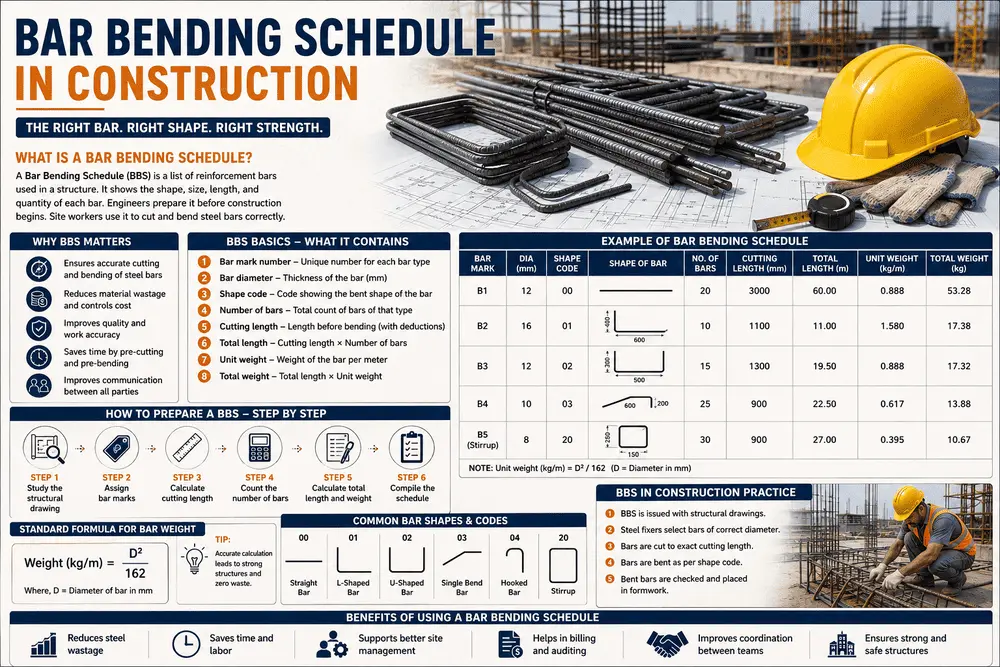
A Bar Bending Schedule (BBS) is a list of reinforcement bars used in a structure. It shows the shape, size, length, and quantity of each bar. Engineers prepare it before construction begins. Site workers use it to cut and bend steel bars correctly.
A BBS is called a bar schedule or schedule of bars. It works as a bridge between the structural drawing and the actual steel work on site.
Why Bar Bending Schedule Matters
Reinforced concrete needs steel bars placed in exact positions. Without a clear plan, workers may cut bars wrong. Wrong cuts waste material and cause delays. A Bar Bending Schedule solves this problem.
For every bar, it provides explicit directions. On-site guesswork is decreased. Steel orders can be planned in advance.
Bar bending in construction is a routine task. It must precisely adhere to the schedule. Even a small error in bar length can weaken a structural member.
Key Uses of Bar Bending Schedule
A BBS serves several purposes on a construction project.
Construction Material estimation
It gives the exact quantity of steel needed. This helps in ordering the right amount, not more, not less.
Construction Cost control
Steel is expensive. Accurate estimation through BBS prevents overordering and reduces wastage.
Quality control
Workers follow the schedule to avoid guessing bar shapes. This keeps reinforcement work consistent and correct.
Time saving
Bars can be cut and bent off-site or in advance. This speeds up construction once site work starts.
Easy communication
A BBS gives one clear document. Engineers, contractors, and workers all refer to the same information.
Basics of Bar Bending Schedule
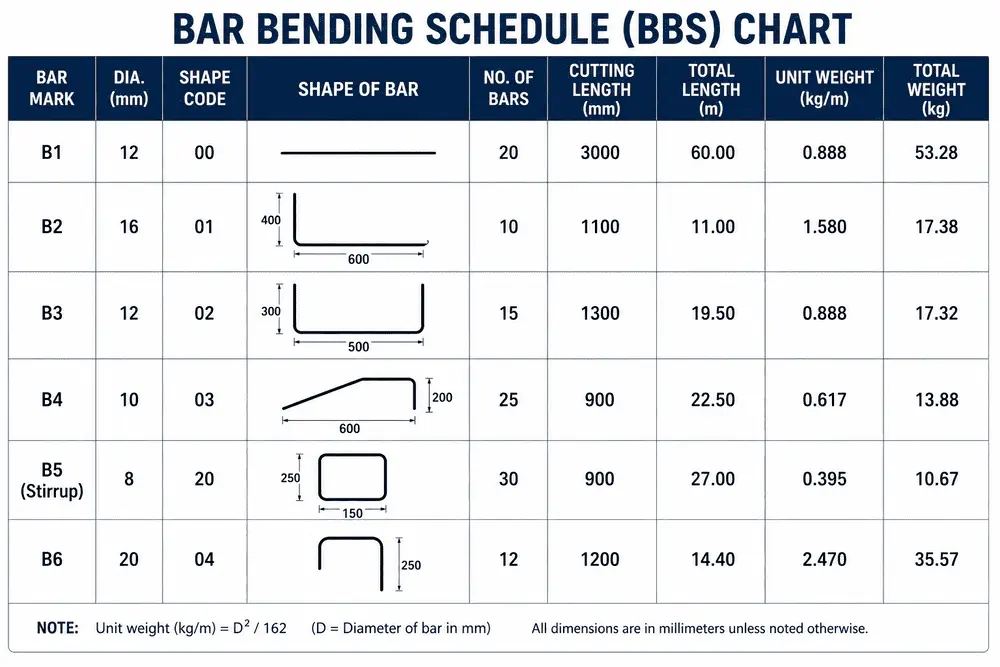
Bar Bending Schedule Basics start with understanding what information the schedule contains. A standard BBS includes these details for each bar.
Bar mark number
A unique number for each bar type in the drawing.
Bar diameter
The thickness of the bar, given in millimeters.
Shape code
A code showing the bent shape of the bar, as per standard codes. Check our BBS Shape Code article.
Number of bars
Total count of bars of that type.
Cutting length
The bar length before bending, calculated with bend deductions.
Total length
Cutting length multiplied by the number of bars.
Unit weight
Weight of the bar per meter, based on its diameter.
Total weight
Total length multiplied by unit weight.
These points form the core of the Bar Bending Schedule Basics that every civil engineer must learn.
How to Prepare a Bar Bending Schedule
Preparing a BBS follows a step-by-step process.
Step 1: Study the structural drawing
Identify each reinforcement bar shown in the drawing. Note its diameter, shape, and location.
Step 2: Assign bar marks
Give each bar type a unique mark number for easy reference.
Step 3: Calculate cutting length
Measure the straight length of the bar. Add extra length for bends and hooks. Subtract bend length because bending shortens the bar slightly.
Step 4: Count the number of bars
Check the drawing to find how many bars of each type are required.
Step 5: Calculate total length and weight
Multiply cutting length by the number of bars. Use standard weight formulas to find the total steel weight.
Step 6: Compile the schedule
Arrange all data in a table format. Include bar mark, diameter, shape, length, and weight.
Standard Formula for Bar Weight
The unit weight of a steel bar is calculated using this formula:
Weight (kg/m) = (D² / 162)
Here, D is the diameter of the bar in millimeters. This formula gives a quick and accurate way to find bar weight without a physical scale.
Common Bar Shapes in a BBS
Reinforcement bars come in several standard shapes. Each shape has a code, defined by structural codes.
- Straight bars
- L-shaped bars
- U-shaped bars
- Bars with a single bend
- Bars with hooks
- Stirrups (used in beams and columns)
Each shape needs a different length calculation, since bending affects the total length used.
Bar Bending Schedule in Construction Practice
On a real construction site, bar bending in construction follows the schedule strictly. Steel fixers, also called bar benders, use the BBS to cut and shape bars.
The process usually happens like this:
The BBS is issued along with the structural drawing.
Steel fixers select bars of the correct diameter.
Bars are cut to the exact cutting length given in the schedule.
Bars are bent according to the shape code.
Bent bars are checked against the schedule before placing them in formwork.
This process keeps reinforcement work accurate and reduces on-site confusion.
Benefits of Using a Bar Bending Schedule
A well-prepared BBS gives several practical benefits during construction.
It reduces steel wastage by giving precise cutting lengths.
BBS saves time, since bars can be pre-cut and pre-bent.
A Bar Bending Schedule supports better site management, since labor and material needs are known in advance.
It helps in billing and auditing, since steel quantities are documented clearly.
By Using BBS, improves coordination between design and site teams.
Bar Bending Schedule in Excel Sample
Most construction engineers prepare a Bar Bending Schedule in Excel, since it makes calculation and formatting easier. A basic Excel BBS sheet includes columns for bar mark, diameter, shape code, number of bars, cutting length, and total weight. Formulas can be added to calculate total length and weight automatically, once diameter and cutting length are entered. This reduces manual calculation errors and keeps the schedule easy to update if the drawing changes. A ready-to-use FREE Bar Bending Schedule Excel template, with sample entries and built-in formulas, is a practical starting point for site engineers and students.
Conclusion
A Bar Bending Schedule is a basic but essential document in construction. It connects the structural drawing to the physical work of cutting and bending steel bars. Learning the Bar Bending Schedule Basics helps engineers estimate materials correctly, control costs, and manage sites efficiently. Every civil engineering student and site professional should understand how to prepare and use a BBS.