
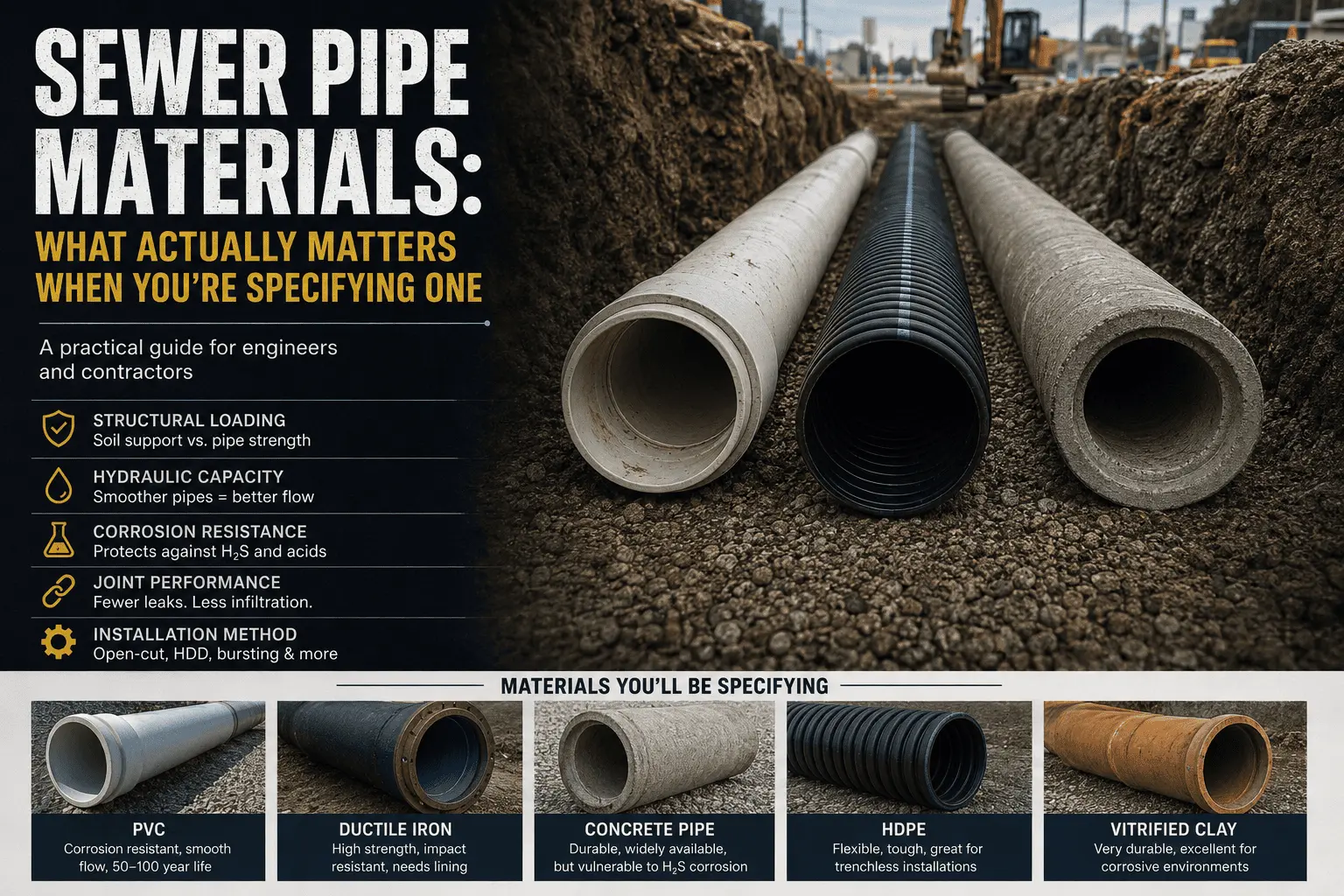
Choosing the Right Sewer Pipe: Engineering Breakdown
Every experienced project engineer has a story about a sewer line that failed years after everyone stopped thinking about it. Usually it’s not a design error in the obvious sense — the hydraulics checked out, the slope was fine on paper. It’s something more mundane: haunching that never got properly compacted, a material chosen because it was what the contractor had on hand, corrosion nobody accounted for because the H2S loading was underestimated. Sewer pipe failures are rarely dramatic. They’re slow, and by the time they show up on a maintenance report, the project team that specified the material has usually moved three jobs down the road.
So this is less a product catalog and more a rundown of what actually separates a sewer pipe that lasts 80 years from one that’s back on someone’s capital improvement list in 25 — written for engineers and contractors who are going to be the ones answering for that decision, whether it’s this year or a decade from now.
First, a Note on Terminology
“Sewer pipe” and “sewage pipe” get used more or less interchangeably in the field, though you’ll notice specs and standards lean toward “sewer pipe” while general contracting docs and commercial scopes tend to say “sewage pipe.” Doesn’t really matter which term you use, but it’s worth knowing both show up, especially if you’re searching through old project records or municipal archives where terminology wasn’t standardized.
Functionally, there are three buckets:
Sanitary sewer pipe carries wastewater from buildings. Storm sewer pipe carries runoff, sized for peak events rather than steady flow. Combined sewer systems carry both — mostly legacy infrastructure at this point, and increasingly something municipalities are being pushed to separate out under CSO regulations. The evaluation criteria overlap across all three, but I’ll focus mainly on sanitary applications since that’s where most of the material debate actually happens.
What You’re Actually Weighing When You Pick a Material
I’ve sat through enough value-engineering meetings to know this conversation usually gets flattened down to cost per linear foot, which misses most of what actually determines whether a pipe performs. A few things genuinely matter more:
Structural loading
Flexible pipe — PVC, HDPE — leans on the surrounding soil to share load. Rigid pipe — concrete, vitrified clay — carries it through the pipe wall itself. This distinction drives everything from bedding class requirements to how forgiving the system is of a contractor who rushes compaction to hit schedule.
Hydraulic capacity
Manning’s n matters more than people give it credit for at the design phase. PVC and HDPE run somewhere around 0.009 to 0.011; concrete’s closer to 0.013. Doesn’t sound like much until you’re sizing a long run and realize a smoother pipe lets you get away with a smaller diameter or a flatter slope, which can genuinely change your depth of cover and excavation costs.
Corrosion
Hydrogen sulfide gas in sanitary sewers converts to sulfuric acid on exposed crown surfaces — this is the mechanism behind most “mystery” concrete pipe failures that show up decades after installation. It’s a slow acid attack nobody sees coming until someone runs a CCTV inspection and finds the crown eaten away.
Joints
This is where infiltration and inflow problems actually originate, and it’s underrated during design because joint performance is invisible until it isn’t. More joints, generally, means more opportunity for root intrusion and groundwater infiltration over the pipe’s service life.
Installation method
Open-cut, HDD, pipe bursting, jack-and-bore — the method you’re using narrows your material options fast, sometimes more than the engineering does.
The Materials You’ll Actually Be Specifying
PVC
This is the default for gravity sanitary sewer in new construction at this point, and for most jobs, there’s not a strong reason to fight that default. Specified under ASTM D3034 for SDR pipe and ASTM F679 for larger diameters, PVC gives you a smooth interior wall, solid chemical resistance — including resistance to the sulfuric acid that eats concrete — and a service life that, done right, runs 50 to 100 years.
The catch, and it’s a real one: PVC’s performance depends heavily on installation quality. It’s a flexible pipe, so it needs the soil around it to actually do its job. I’ve seen deflection failures traced straight back to haunch zones that got backfilled and compacted too fast because someone was chasing a schedule milestone. If you’re specifying PVC, the material selection is honestly the easy part — the inspection regime around bedding and backfill compaction is where the real risk sits.
Ductile Iron and Cast Iron
Cast iron dominated municipal sewer construction through roughly the mid-20th century. Ductile iron, under AWWA C151, replaced it for applications that genuinely need high structural capacity — pipe bridges, casings, anywhere external loading gets severe.
It’s strong, it takes impact well, and it’s a rigid pipe classification, which changes how it interacts with the surrounding soil. But sanitary applications require an interior lining — cement-mortar or polyethylene, typically — because unlined iron corrodes badly in that environment. And it’s expensive, both in material and installation, compared to plastic alternatives. A lot of legacy cast iron infrastructure from before the 1970s is now sitting at or past design life, which is a big part of why CIPP lining and full replacement programs show up so often in municipal capital plans right now.
Vitrified Clay Pipe
Still shows up in specs under ASTM C700, mostly in jurisdictions with a lot of existing clay infrastructure where matching materials for a rehab project makes sense. Its chemical resistance is genuinely excellent — about as inert to wastewater as a pipe material gets.
But it’s brittle under point loading, and the shorter pipe sections historically used mean more joints per linear foot than you’d get with modern fused or long-run systems. More joints means more root intrusion risk, and clay’s reputation for root problems is well-earned. Most engineers I know only spec new VCP for replacement-in-kind work at this point; for anything new, PVC or HDPE has largely taken over.
HDPE
If you’re doing trenchless work — rehab or replacement — HDPE has basically become the standard, specified under ASTM F714 and AWWA C906 for the bigger diameters. The fusion-welded joints are the real selling point here: no gaskets, no infiltration points at every joint, which is a meaningful difference over a pipe’s service life.
It handles seismic movement and differential settlement well because of its flexibility, and it’s about as root-resistant as anything on the market thanks to the seamless run. The one thing worth flagging for design teams: HDPE’s coefficient of thermal expansion is noticeably higher than PVC’s, so shallow-cover or aboveground sections need real attention to thermal stress management during installation. It’s an easy detail to skip in the rush of a trenchless project timeline, and it shouldn’t be.
Reinforced Concrete Pipe
Reinforced Concrete Pipe (RCP) is still the go-to for large-diameter storm and combined sewer work, spec’d under ASTM C76. It handles deep burial and heavy surcharge conditions about as well as anything available, and it stays economical at large diameters in a way plastic pipe generally doesn’t.
Sanitary applications are where it gets tricky — without a protective lining (HDPE or PVC liner, or a calcium aluminate cement mix design) crown corrosion from H2S exposure will eventually compromise it. Joint performance also depends a lot on gasket spec and how tight the installation tolerances were held, which is worth double-checking on inspection rather than assuming from the submittal.
ABS
Less common than it used to be for gravity sewer work, though it still gets specified in certain regions and shows up more in cold-climate jobs, where its low-temperature impact resistance is a genuine advantage over PVC.
Hydraulically it performs about the same as PVC, and solvent-welded joints simplify installation in some conditions. The thing to watch is UV degradation during storage — if pipe sits staged on site too long before installation, that’s a real durability concern, not a theoretical one. Code acceptance also varies more by jurisdiction than PVC does, so that’s worth confirming before it ends up in a spec.
When You’re Rehabbing Instead of Building New
A good chunk of the work civil engineers deal with these days isn’t new sewer construction — it’s rehabilitating what’s already in the ground. A few methods worth knowing cold:
CIPP — cured-in-place pipe — cures a resin-saturated liner inside the existing host pipe, effectively building a new pipe within the old one. Works across a wide range of host materials and diameters, which is part of why it’s so widely used.
Pipe bursting fragments the existing pipe (usually clay or cast iron) while pulling a new HDPE pipe into the same alignment, often letting you upsize capacity in the process.
Sliplining threads a smaller liner — HDPE or PVC — into the host pipe. Simpler, generally cheaper, but you lose some diameter in the process, so it’s worth running the hydraulic numbers again before assuming it’ll cover projected flow.
Whatever method you’re leaning toward, it should be grounded in an actual condition assessment — CCTV inspection following NASSCO PACP standards, ideally — rather than an assumption about what state the host pipe is in. I’ve seen rehab specs written off of decades-old as-built drawings with no current inspection data behind them, and that’s how projects end up with change orders mid-construction.
Quick Comparison
| Material | Typical Service Life | Relative Cost | Root Resistance | Where You’ll See It |
| PVC | 50–100 years | Low–Moderate | High | New construction, standard gravity mains |
| HDPE | 50–100 years | Moderate | Very High | Trenchless rehab, seismic zones, unstable soil |
| Ductile Iron | 75–100+ years | High | High (with lining) | High-load crossings, casings, bridges |
| VCP | 50–60 years | Moderate | Low | Legacy systems, replacement-in-kind |
| RCP | 50–100 years | Moderate–High | Moderate | Large-diameter storm and trunk sewers |
| ABS | 50–80 years | Low–Moderate | High | Cold-climate applications |
The Part That’s Easy to Forget
None of this holds up if it gets treated as a default checkbox decision. Soil conditions, groundwater table, seismic risk, traffic loading, actual corrosion potential for the specific application, and the realities of the project budget all pull in different directions, and local code ultimately overrides whatever the engineering preference might be anyway. On rehab work especially, I’d push back on any material decision made without a current condition assessment behind it — the state of what’s already buried usually matters more to the outcome than whatever spec sheet you’re comparing it against.