
How to Calculate Area of a Plot
Knowing how to calculate area sounds easy in a classroom, but it feels a lot harder when you’re standing on a real piece of land with a measuring tape, not sure where to start. The good part is, most of the time you just need to break a strange shape into simpler shapes, and then add up the pieces.
Start With the Basic Formula
If a plot is a perfect rectangle or square, this part is easy. Just multiply length by width. So a plot that is 30 metres long and 15 metres wide gives you 450 square metres. That’s it.
But real plots are almost never this simple. Corners get cut at weird angles, one side is longer than the other, or the whole shape narrows near the back. That’s when just using length times width won’t give you the right answer anymore.
Measuring a Plot With an Odd Shape
Most plots are not perfect rectangles, and this is where a lot of people get confused. The trick is to think of the plot as many small shapes joined together, not one single shape.
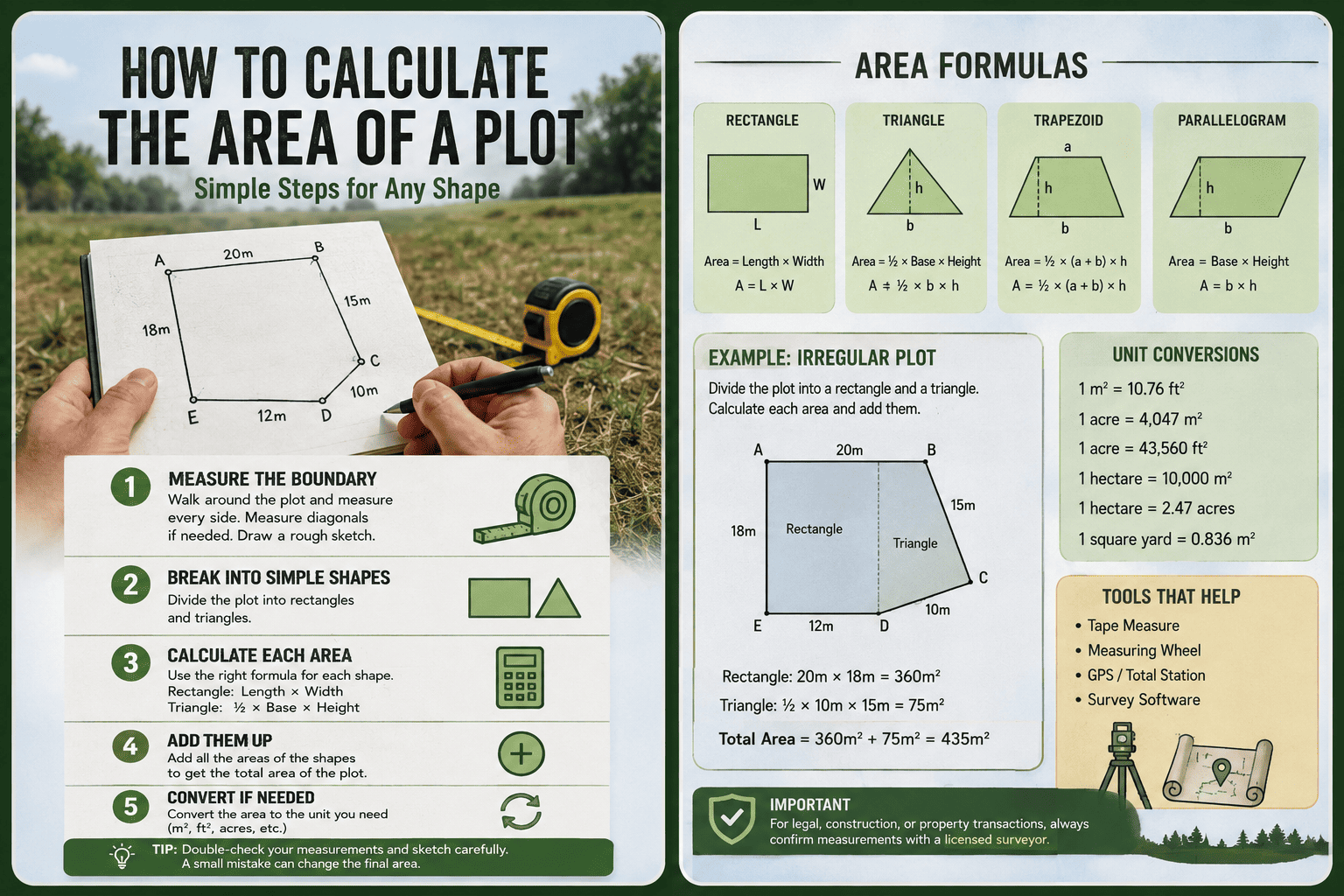
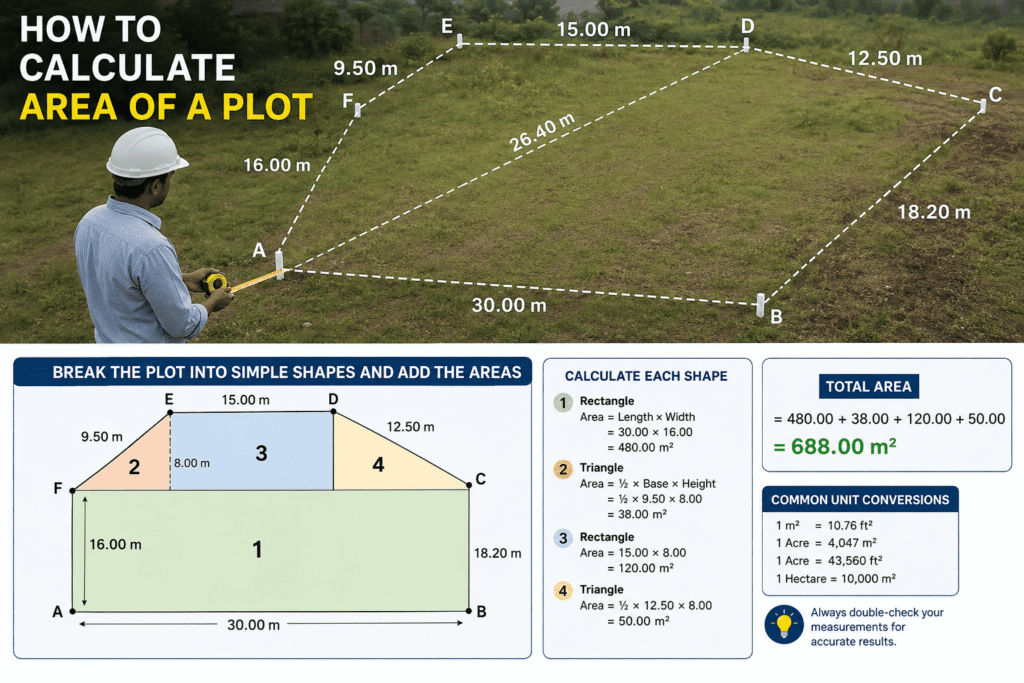
First, walk around the boundary of the plot and measure every side. If there are angled edges, measure the diagonal lines too. It helps to draw this out on paper as you go, even if it’s a rough sketch. Once you have all the side lengths written down, split the shape into rectangles and triangles. Find the area of each small shape one at a time, then add all of them together to get the total.
For a triangle, the formula is half of base times height. So if one triangle part has a base of 8 metres and a height of 5 metres, that piece alone is 20 square metres. Add this to the rectangle parts, and you get the full area of the plot.
Using Diagonals for Tricky Shapes
Sometimes a plot doesn’t split neatly into rectangles and triangles, especially if the edges curve or the angles are strange. In this case, it’s easier to draw diagonal lines across the plot to split it into several triangles instead. Measure the base and height of each triangle, calculate each area, and add them up. It takes more time, but it gives a much more correct answer than just guessing.
Converting Units
Plot sizes are written in different units depending on the place, square feet, square metres, square yards, acres, hectares, and in some areas even units like cents or guntha. Knowing how to switch between these is just as important as the calculation itself, because a builder, a bank, and the land registry office might all want the size in a different unit.
Here are a few conversions worth remembering. One square metre is about 10.76 square feet. One acre is about 4,047 square metres, which is close to 43,560 square feet. It’s best to do all your calculations first and only convert at the very end, so small rounding mistakes don’t add up.
Tools That Make It Easier
For small plots, a tape measure and simple maths are enough. But for big or oddly shaped land, some tools help a lot. Equipment like a total station or GPS survey tools can mark exact boundary points, and this data can be used with area calculation software. Even something simple like Google Earth’s measuring tool can give a rough idea quickly, but for anything official, like buying land or applying for a loan, it’s better to get an actual survey done.
Why Getting It Right Matters
Calculating plot area correctly isn’t just useful for school exams. It affects property value, construction permits, taxes, and loan approvals. Even a small mistake of a few square metres can throw off building costs or cause arguments with neighbours about where the boundary actually is. For anything legal or involving a lot of money, it’s smart to get a licensed surveyor to double check the numbers instead of only trusting your own measurements.
In the end, calculating area is not really hard maths. It mostly needs patience, breaking a messy shape into simple parts, and checking your measurements twice before trusting the final number.