
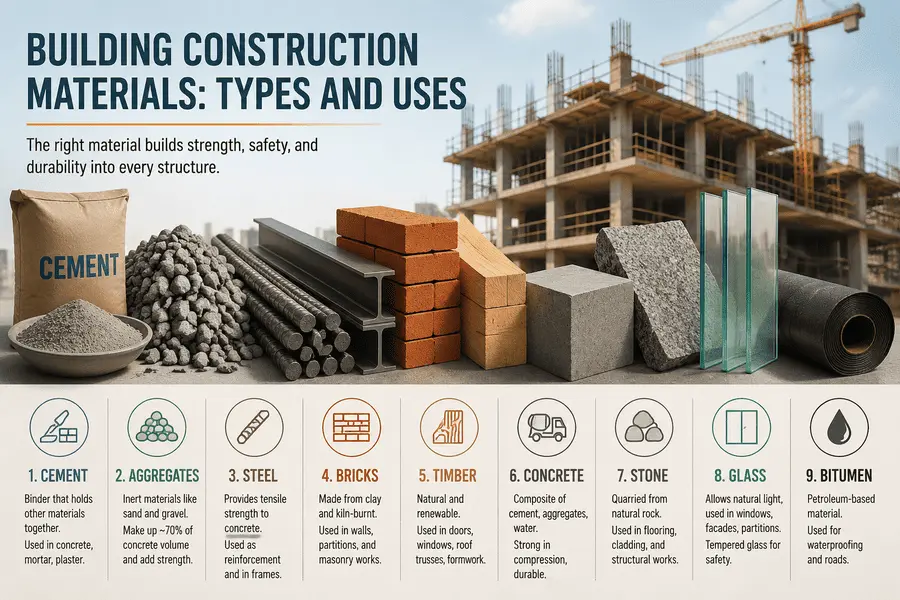
Building Construction Materials: Types and Uses
No structure comes up without a choice of material first. The strength, durability, and overall cost of a building depend on the building material selected for it. A civil engineer needs to know the properties of each material before putting it to use on site. This article looks at the common types of construction materials used in the building industry, along with where and why each one fits.
What is a Building Material?
A building material is any substance used for construction work. Some are natural, like stone and timber. Others are manmade, like cement and steel. What gets chosen for a project usually comes down to load requirement, local climate, availability, and budget. There is rarely one right answer here, only trade offs.
Classification of Building Materials
Construction and building materials fall into two broad groups.
1. Natural materials – used in raw or lightly processed form. Stone, timber, and clay belong here.
2. Manmade materials – produced through industrial processing. Cement, steel, and bricks belong here.
Common Types of Building Materials
1. Cement
Cement acts as a binder. It is produced by grinding clinker along with gypsum, and once mixed with water, it hardens and holds other materials together.
Setting Time – Ordinary Portland Cement begins its initial set in about 30 minutes.
Strength Gain – Most of its strength develops over 28 days of curing, though it keeps gaining slowly after that too.
Application – Found in concrete, mortar, and plastering work.
2. Aggregates
Aggregates are the inert filler mixed with cement and water to make concrete. They come in two broad sizes.
(I). Fine aggregate – particles under 4.75 mm, sand being the common example.
(II). Coarse aggregate – particles above 4.75 mm, such as gravel and crushed stone.
Aggregates make up close to 70 percent of concrete’s volume, which is why their quality has such a direct bearing on the strength of the finished structure.
3. Steel
Steel is an alloy of iron and carbon, valued mainly for the tensile strength that concrete does not have on its own.
Reinforcement – Bars are embedded in concrete to take up tensile forces.
Structural Sections – Rolled shapes like I-beams and channels form the frames of steel buildings.
Corrosion Risk – Moisture causes steel to rust over time, so coatings or galvanising are used to protect it.
4. Bricks
Bricks are among the oldest house building materials still in regular use. They are made by moulding clay into blocks and burning them in a kiln.
(I). First class bricks are smooth surfaced with sharp, well defined edges.
(II). Second class bricks are rougher and get used in spots that will be plastered over anyway.
(III). Third class bricks are limited to temporary work.
5. Timber
Timber is processed wood used in building work. Being a natural material, it can be renewable if the forest source is managed well.
Strength – Good along the grain, but noticeably weaker across it.
Durability – Left untreated, timber decays fast once moisture and insects get to it.
Typical Use – Doors, windows, roof trusses, and formwork.
6. Concrete
Concrete is a composite of cement, aggregates, water, and sometimes admixtures. It is probably the most used construction material today, mostly because it can be moulded into almost any shape and still hold up under load.
Compressive Strength – Strong under compression, weak under tension.
Workability – Fresh concrete flows into whatever formwork it is poured into.
Durability – Properly cured concrete can stay in service for decades, sometimes longer.
7. Stone
Stone is quarried straight from rock formations and has been in use since ancient construction.
(I). Granite is hard wearing, often used for flooring and countertops.
(II). Sandstone is softer and better suited to wall cladding.
(III). Limestone is mostly used as a raw material in cement production.
8. Glass
Glass has become a regular feature in modern buildings, used for windows, facades, and partitions. It lets in natural light in a way few other materials can.
Fire Resistance – Ordinary glass fails quickly under heat. Tempered or fire rated glass is used wherever safety is a concern.
Thermal Performance – Double glazing cuts down heat transfer and helps with energy efficiency.
9. Bitumen
Bitumen comes out of petroleum refining. It is black, sticky, and used mainly for waterproofing and road work.
Waterproofing – Applied on roofs and foundations to keep water out.
Flexibility – Stays pliable at normal temperatures, which helps it resist cracking over time.
What Decides the Choice of Construction Material
Selecting a material is not a guess. Engineers weigh a few things before settling on one.
- Strength the structure will actually need.
- Durability against weather and chemical exposure.
- Cost and how easily the material is available locally.
- Ease of transport and handling on site.
- Fire resistance and other safety requirements.
Conclusion
Building materials used in construction differ widely in properties and in the jobs they do. Cement, aggregates, and steel remain the backbone of most modern structures, while timber, stone, and bricks still hold their place for specific uses. Knowing the construction materials used on a project, and why, is what lets engineers build something safe, durable, and reasonably economical.