
How to Calculate Plaster: Cement and Sand Quantity for Plastering
Plastering is the thin layer of mortar you see on a wall or ceiling. It covers the rough surface underneath and keeps out moisture and provides a smooth base to paint on. If you are on site you can’t just guess the material quantity and hope it will work. You need to have a proper plastering calculation formula to order the right amount of cement and sand, not too little, not too much.
This article walks through that calculation, in square metres and square feet both.
Why Bother Calculating It Properly
Generally, a poor estimate of plastering will reveal itself one of two ways. You’re halfway thru a wall and you run out of cement, and you can’t work, or you order too much and it just sits there wasted. Neither is kind to the budget. It also matters when you are preparing a BOQ, as the client or contractor will be holding to those numbers.
Points to Keep in Mind Before You Start
A few basics, before the maths.
1. Wall plastering normally uses a cement to sand ratio of 1:6.
2. Ceiling plastering is richer, usually 1:4.
3. Thickness should stay between 12 mm and 15 mm. If the wall needs more than that, do it in two coats rather than piling it on in one go.
4. Don’t skimp on material quality. Poor sand or old cement will show up as cracks later.
5. Use a measuring box on site. A head pan is not accurate enough for this.
The Plastering Calculation Formula
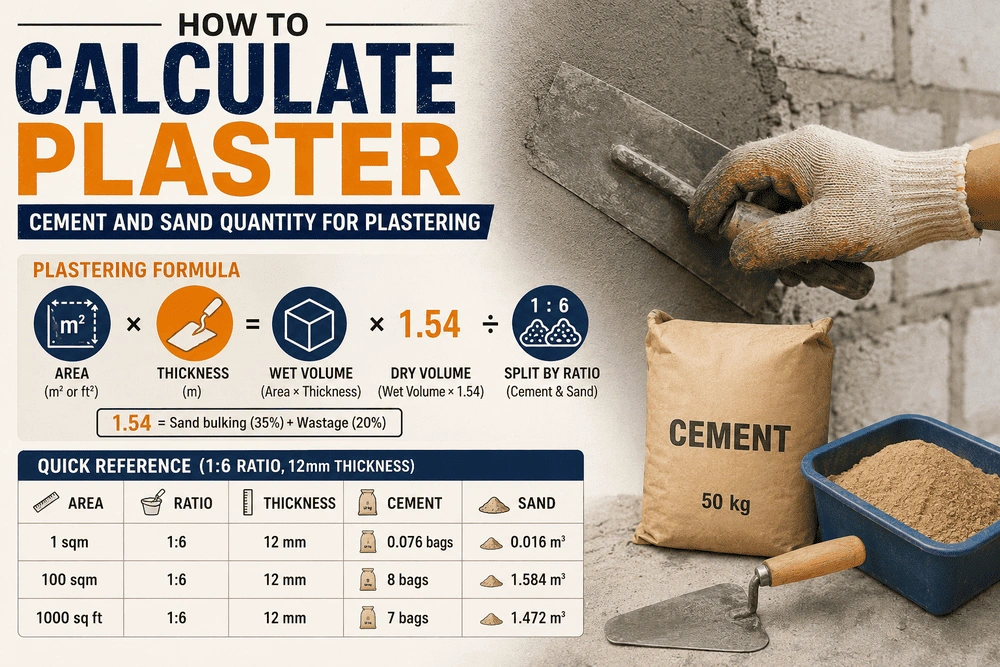
Here’s the logic behind it. First, you find the wet volume of mortar, which is just the area multiplied by thickness.
Wet volume = Plastering area × Thickness
That’s the volume after water is added, but cement and sand are bought dry, not wet. So you need to convert. Sand bulks up by roughly 35% when it’s damp, and there’s usually another 20% lost to wastage while mixing and applying. Add those together and you get a constant of 1.54, which you multiply into the wet volume to get the dry volume.
Dry volume = Wet volume × 1.54
Once you’ve got dry volume, split it by the ratio to find cement and sand separately.
Cement and Sand Required for 1 Sqm Plastering
Say you’re plastering 1 sqm at 12 mm thickness, ratio 1:6.
Wet volume = 1 × 0.012 = 0.012 m³ Dry volume = 0.012 × 1.54 = 0.01848 m³
Ratio total = 1 + 6 = 7
Cement = 0.01848 × 1/7 = 0.00264 m³ Sand = 0.01848 × 6/7 = 0.01584 m³
Convert cement to bags by dividing by 0.0347 m³ (one 50 kg bag). That works out to roughly 0.076 bags per sqm. Doesn’t sound like much on its own, but it adds up fast once you’re covering a whole wall.
How Much Sand and Cement Is Required for Plastering a Larger Area?
Small numbers are hard to picture, so let’s scale it up to 100 m², still at 12 mm and 1:6.
Wet volume = 100 × 0.012 = 1.2 m³ Dry volume = 1.2 × 1.54 = 1.848 m³
Cement = 1.848 × 1/7 = 0.264 m³, which comes to about 7.6 bags. Round that up to 8 bags, since you’ll always want a bit of buffer on site.
Sand = 1.848 × 6/7 = 1.584 m³
So for 100 sqm of wall plastering, budget for 8 bags of cement and roughly 1.6 cubic metres of sand.
Plastering Calculation in Sq Ft
Not every site works in metres. If your drawing is in square feet, the method doesn’t change, just the units.
Take 1000 sq ft at 12 mm (0.0394 ft) thickness, 1:6 ratio.
Wet volume = 1000 × 0.0394 = 39.4 ft³, which converts to about 1.115 m³. Dry volume = 1.115 × 1.54 = 1.717 m³
Cement = 1.717 × 1/7 = 0.245 m³, roughly 7 bags after rounding Sand = 1.717 × 6/7 = 1.472 m³
So 1000 sq ft of plastering needs about 7 bags of cement and 1.47 m³ of sand.
Quick Reference
| Area | Ratio | Thickness | Cement | Sand |
| 1 sqm | 1:6 | 12 mm | 0.076 bags | 0.016 m³ |
| 100 sqm | 1:6 | 12 mm | 8 bags | 1.584 m³ |
| 1000 sq ft | 1:6 | 12 mm | 7 bags | 1.472 m³ |
Conclusion
This is none of it complicated once you’ve done it a couple of times. Area x thickness = wet volume x 1.54 = dry volume / ratio It works the same whether you are measuring in square meters or square feet and will save you from both shortages and wasted bags on site.
FAQs
What ratio of cement and sand is used for plastering?
Walls typically use 1:6. Ceilings need a richer mix, usually 1:4.
How thick should plaster be?
Between 12 mm and 15 mm. Anything thicker should go on as a second coat, not all at once.
Why do we multiply by 1.54 in the calculation?
It accounts for sand bulking (about 35%) and wastage during mixing and application (about 20%), converting wet volume to dry volume.
How many cement bags does 100 sqm of plastering need?
Around 8 bags, at 12 mm thickness and a 1:6 ratio.
Does the formula change if I’m working in square feet instead of square metres?
No, the steps stay the same. Just convert the area and thickness into feet first, then run through the same wet volume, dry volume, and ratio split.