
Types of Columns in Construction: 7 Types Explained
Every structure you’ve ever walked into stands on columns, but not all columns do the same job. Some carry weight straight down through their center. Others are pushed sideways by a beam that only frames in from one side. Knowing the types of columns in construction, and why each one exists, is one of the first things that separates a working design from a guess.
What Is a Column, Exactly?
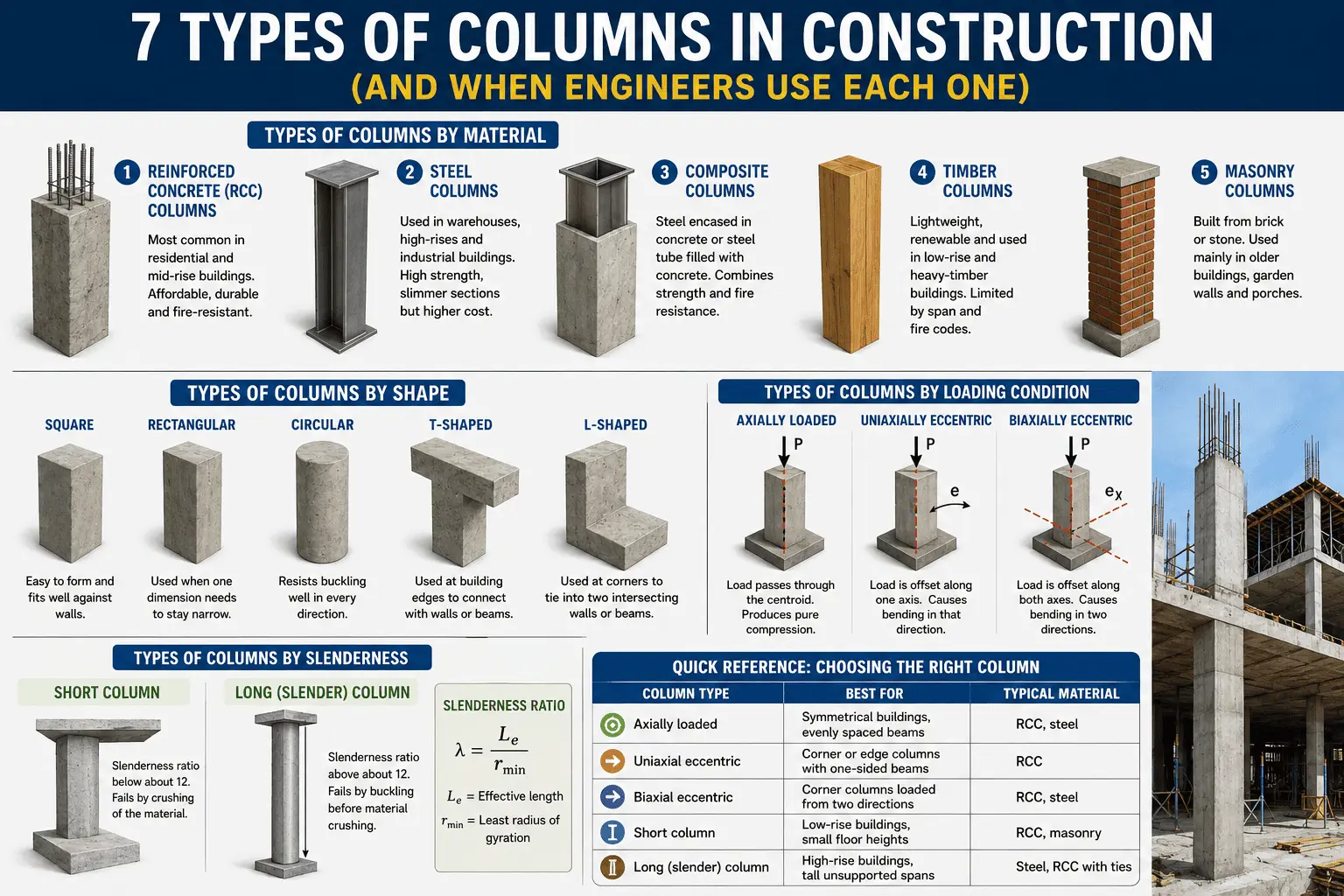
A column is a vertical structural member that transfers loads from beams, slabs, or roofs down to the foundation, mainly through compression. Engineers classify columns three different ways: by the material they’re built from, by their cross-sectional shape, and by how the load is applied. A single column often fits into all three categories at once — for example, a short, square, axially loaded RCC column.
Types of Columns by Material
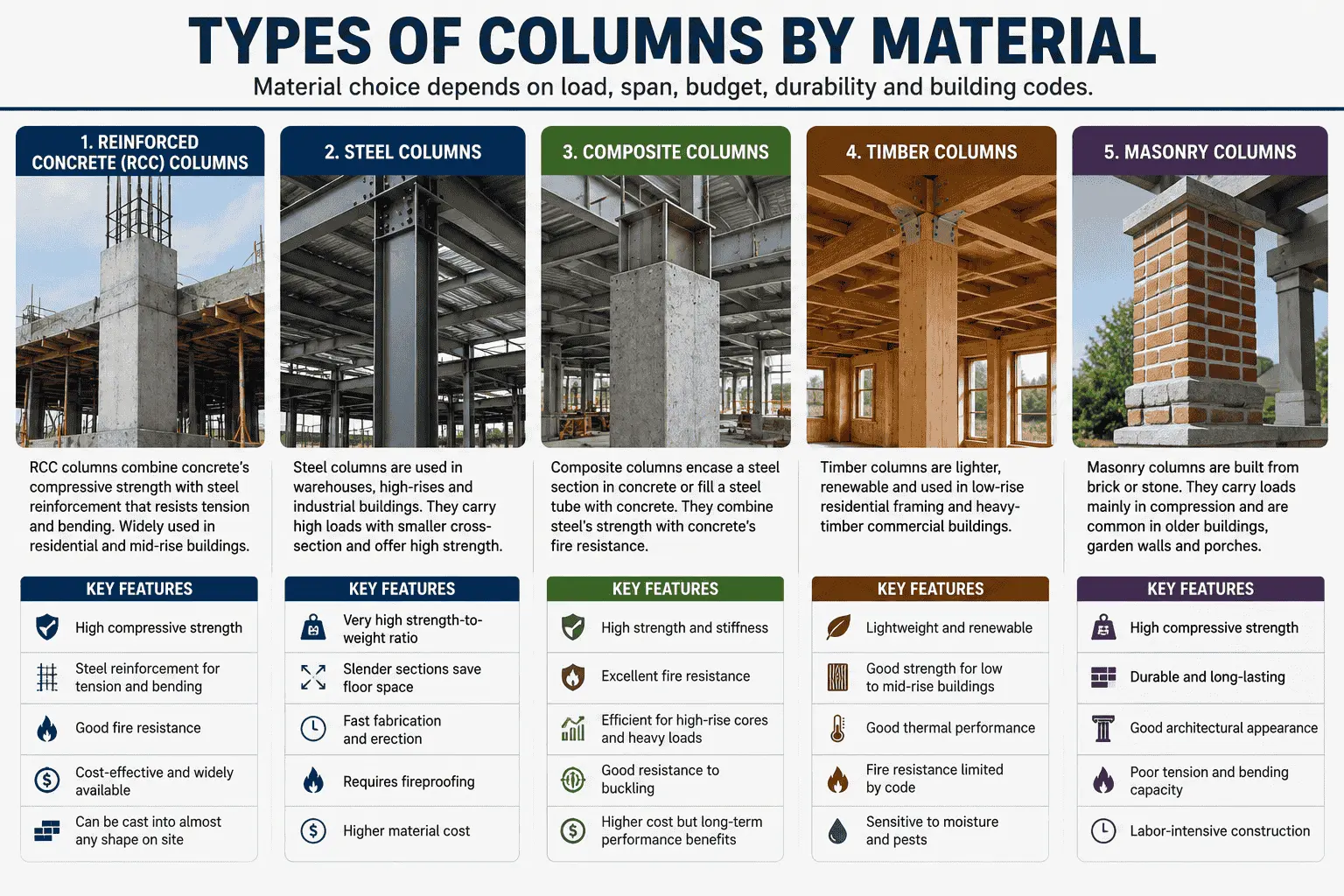
Material choice depends on load, span, budget, and local building code. Here’s how the five most common materials stack up.
1. Reinforced Concrete (RCC) Columns
RCC columns combine concrete’s compressive strength with steel reinforcement bars that handle tension and bending. They’re the default choice for residential and mid-rise buildings across the U.S. because the material is affordable, fire-resistant, and can be cast into almost any shape on site.
2. Steel Columns
Steel columns show up in warehouses, high-rises, and industrial buildings. A steel section carries far more load per unit of cross-sectional area than concrete, so columns can be slimmer, which matters when floor space is expensive. The tradeoff is cost and the need for fireproofing.
3. Composite Columns
A composite column encases a steel section inside concrete, or fills a steel tube with concrete. You get steel’s strength and concrete’s fire resistance in one member, which is why composite columns have become common in modern high-rise cores.
4. Timber Columns
Timber columns are lighter and renewable, and they still appear in low-rise residential framing and heavy-timber commercial buildings. Engineered wood products like glulam have pushed timber back into taller construction, though span and fire code limit where it’s allowed.
5. Masonry Columns
Built from brick or stone, masonry columns carry load mainly in compression and show up most often in older buildings, garden walls, and porches rather than in new structural framing.
Types of Columns by Shape
Shape affects both strength and appearance.
A square column is easy to form and fits cleanly against walls.
A rectangular column suits spaces where one dimension needs to stay narrow.
A circular column resists buckling well in every direction because its radius of gyration doesn’t change no matter which way the load pushes.
A T-shaped or L-shaped column is used at building edges and corners, where it needs to tie into two intersecting walls or beams.
Types of Columns by Loading Condition
This is the classification that actually drives the design calculations, so it’s worth slowing down on.
Axially Loaded Columns
The load passes straight through the centroid of the column, producing pure compression with no bending. Interior columns in a symmetrical building, with beams framing in evenly from all sides, are usually axially loaded.
Uniaxially Eccentric Columns
The load is offset from the centroid along one axis, which adds bending in that direction on top of the compression. Edge columns, where a beam frames in from only one side, fall into this category.
Biaxially Eccentric Columns
The load is offset along both axes at once. Corner columns are the classic example, since beams frame in from two directions simultaneously and neither load lines up with the centroid.
Types of Columns by Slenderness
Slenderness ratio compares a column’s unsupported length to its least lateral dimension. Below roughly 12, a column is considered short and fails by the material crushing. Above that, it’s a long or slender column, and buckling becomes the governing failure mode long before the material reaches its crushing strength. This is exactly why tall buildings need steel or composite columns rather than short, stubby masonry piers.
| Column Type | Best For | Typical Material |
| Axially loaded | Symmetrical buildings, evenly spaced beams | RCC, steel |
| Uniaxial eccentric | Corner or edge columns with one-sided beams | RCC |
| Biaxial eccentric | Corner columns loaded from two directions | RCC, steel |
| Short column | Low-rise buildings, small floor heights | RCC, masonry |
| Long (slender) column | High-rise buildings, tall unsupported spans | Steel, RCC with ties |
Quick Reference: Choosing the Right Column
A few rules of thumb engineers actually use on site:
Interior, symmetrical spans → axially loaded RCC column
Edge of the building → uniaxial eccentric design
Building corner → biaxial eccentric design, usually with a larger cross-section
Floor height under about 10 feet → short column rules apply
High-rise or long unsupported height → slender column design with steel or composite sections
The Bottom Line
The types of columns in construction aren’t just textbook categories — they show up in every set of structural drawings you’ll ever read. Get the material, shape, and loading condition right, and the column does its job quietly for the next hundred years. Get it wrong, and it’s the first thing that fails.
Frequently Asked Questions
What are the main types of columns in construction?
The main types of columns in construction are classified by material (concrete, steel, composite, timber, and masonry), by shape (square, rectangular, circular, and T-shaped), and by loading condition (axially loaded, uniaxially eccentric, and biaxially eccentric).
What is the difference between a short column and a long column?
A short column has a slenderness ratio below about 12, so it fails by crushing under load. A long (slender) column has a higher slenderness ratio and tends to fail by buckling before the material itself crushes.
Which type of column is strongest?
Circular columns generally resist buckling and lateral loads better than square or rectangular columns of the same cross-sectional area, because their radius of gyration is uniform in every direction.
Why are steel columns used in high-rise buildings?
Steel columns are used in high-rise buildings because steel has a high strength-to-weight ratio, allowing slender columns to carry heavy loads over long unsupported heights without adding excessive dead weight to the structure.
What is an eccentrically loaded column?
An eccentrically loaded column carries a load that does not pass through the centroid of its cross-section, which creates bending in addition to axial compression. This commonly happens at corner or edge columns where beams frame in from only one or two sides.