
Types of Culverts in Construction
What is a culvert, exactly? It’s a small drainage structure, usually under 6 metres long, built to let water pass beneath a road or railway line. Picture a mini bridge tucked under the embankment so the stream keeps flowing while traffic keeps moving above it. Nobody notices culverts until one fails, but they quietly do a lot of work in every road network.
There isn’t just one way to build one though. The type used depends on the site, the soil, the water flow, and the budget, and each type solves the problem a bit differently.
Arch Culvert
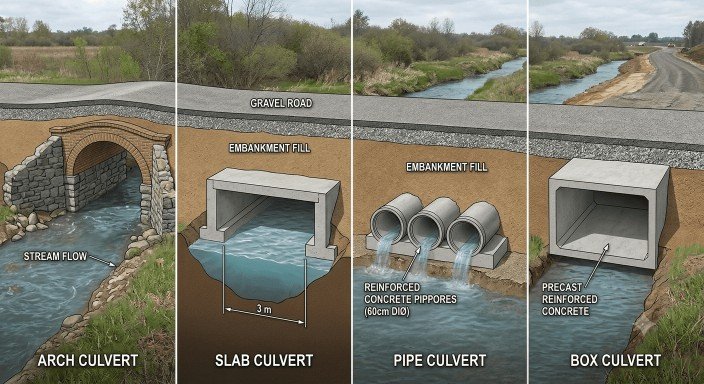
An arch culvert uses one or two arches as its main structure, usually built from brick, stone, or concrete. Arches are a genuinely old idea and they’re cheap to build once the formwork is sorted, since the shape naturally handles load well. The abutments and piers supporting the arch need to be solid, because arches push outward as well as down, and that sideways thrust has to go somewhere. Arch culverts work particularly well where the road approach is being built in a cutting, since the arch shape fits that kind of terrain naturally.
Slab Culvert
A slab culvert, sometimes called an open or box-less culvert, relies on a reinforced concrete slab sitting simply on top of abutments and piers. It’s a straightforward design, basically a flat concrete lid over an opening, and it works best where the stream bed is firm enough to support the structure without much settling. Span length is the main limitation here. Slab culverts generally top out around 3 metres, so they’re suited to smaller channels rather than wide waterways.
Pipe Culvert
Pipe culverts are exactly what they sound like: one or several pipes, made of cast iron, steel, or reinforced concrete, laid over a concrete base under the embankment. When water flow is light, a single pipe might do the job, but for higher flow, several pipes get laid side by side, each at least 30 centimetres in diameter. Getting the slope right matters a lot here, with a gradient of roughly 1 in 1000 as a rough minimum, since a poorly sloped pipe culvert struggles to drain properly and can silt up over time.
Box Culvert
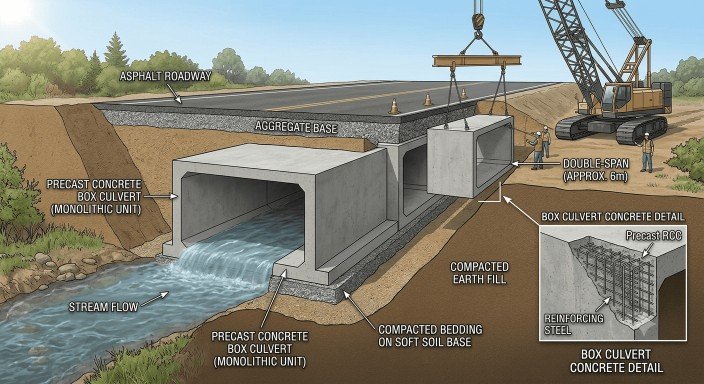
A box culvert has rectangular or square openings, with the top slab, floor, and side walls all cast together as one monolithic unit. Box culvert concrete is typically precast RCC, though smaller spans sometimes get built with stone slabs on masonry abutments instead. What makes box culverts popular is how little they interfere with road traffic during construction, and how well they perform on soft soil, since the load spreads across a wider base than a pipe or slab design would allow. A single box culvert span usually maxes out around 3 metres, though a double-span version can stretch to about 6 metres.
Choosing Between Them
None of these four types is universally better. Soil strength, water flow, span needed, and construction budget all steer the decision, and on a lot of sites, the final choice comes down to what local materials and skilled labour can deliver most reliably.