
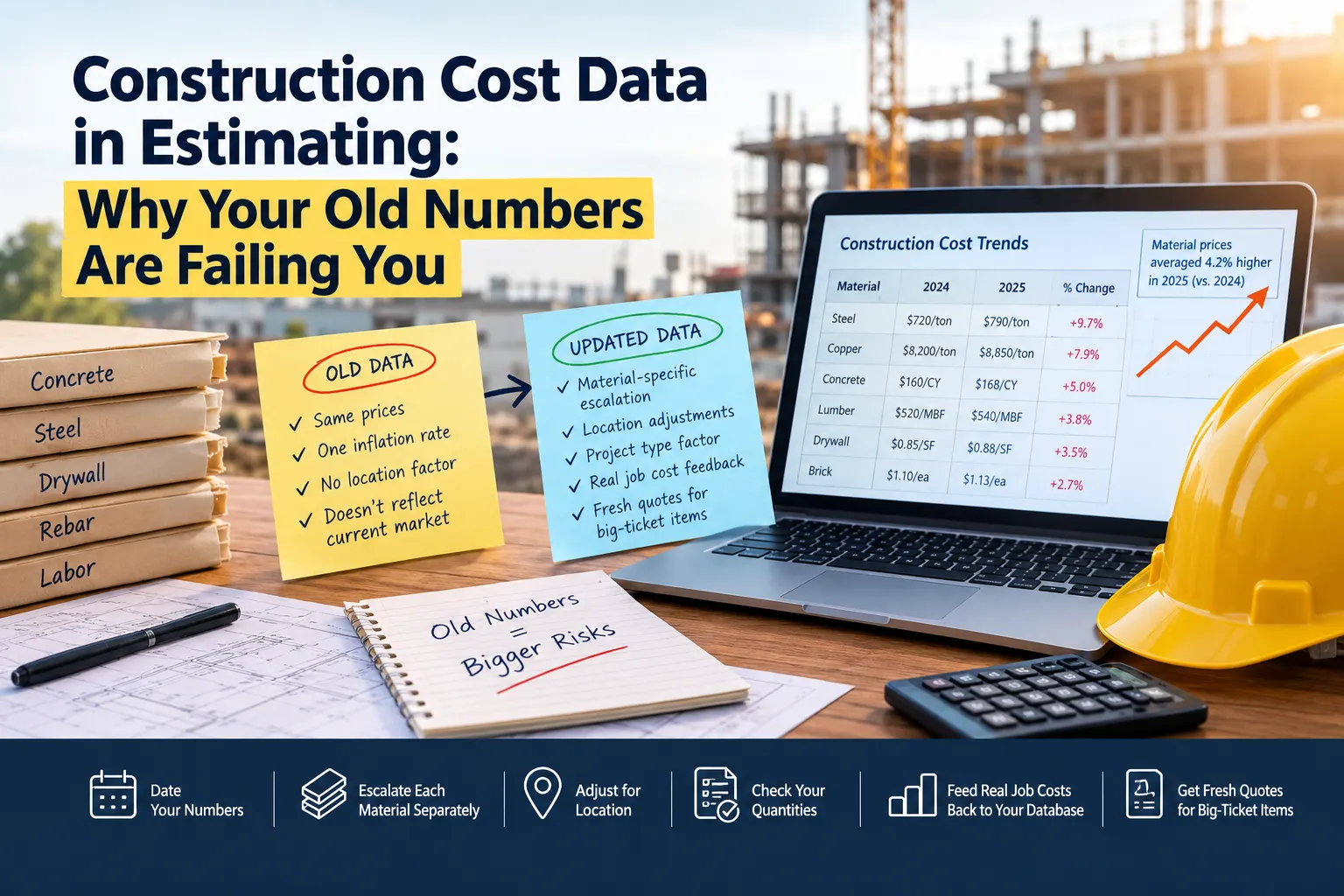
Construction Cost Data in Estimating: Why Your Old Numbers Are Failing You
Every estimator has that one spreadsheet. The one with years of unit costs, built up job after job. Cost per yard of concrete. Cost per square foot of drywall. Cost per ton of rebar. It’s been your best friend for years.
Right now, it might be lying to you.
Historical construction cost data used to be the most reliable tool an estimator had. Prices moved slowly and predictably, so last year’s number plus a few percent usually worked. That’s not the world we’re in anymore. JLL reported that material prices in 2025 averaged about 4.2% above 2024, and costs have kept rising unevenly since. Some materials jumped. Others barely moved. And the change varies a lot depending on where you build and what you build.
Old data isn’t useless. But using it without adjusting it is one of the fastest ways to lose money on a job.
Why Historical Cost Data Goes Wrong
There are a few reasons your trusted numbers can mislead you now.
Prices don’t move together. A single inflation percentage applied to your whole database assumes everything rose at the same rate. It didn’t. Steel and copper have been far more volatile than, say, bricks or sand. One blanket adjustment will be too high on some items and too low on others.
Location matters more than ever. A cost from a job in Texas might be way off for a job in New Jersey. Labor rates, material availability, and local demand all vary. And with data center construction booming in certain regions, labor and materials are getting pulled toward those markets.
The project type matters. Unit costs from a simple warehouse don’t translate well to a hospital or a lab, even if the materials look similar on paper.
Old jobs had their own quirks. Maybe that job had great weather, an all-star crew, or a supplier who gave you a deal. Those conditions won’t repeat on your next job.
6 Ways to Keep Your Cost Data Accurate
1. Put a Date on Every Number
Every unit cost in your database should have a date and a source attached. “Concrete, $185/CY” means nothing without knowing it came from a March 2024 quote in Dallas. Once you start dating your numbers, it’s easy to see which ones need updating.
2. Escalate Each Material on Its Own
Instead of one percentage for everything, adjust each major material category separately. Use the Bureau of Labor Statistics Producer Price Index for specific materials to see how much each one has actually moved since your data was recorded.
Escalate to the midpoint of construction, not just to bid day. If the job takes 18 months, a lot of the material gets bought months after you submit.
3. Adjust for Location
When using data from another region, apply a location factor. Published cost guides include city-by-city adjustments, and they’re a good starting point. Better yet, call a local supplier or two and check whether your number holds up.
4. Check Your Quantities, Not Just Your Prices
Bad cost data isn’t always about price. Sometimes the unit rate itself is off because it was based on bad quantities or the wrong mix. Go back to the basics now and then. For concrete work, make sure you understand how concrete mix ratios affect material quantities. For finishes, double-check things like cement and sand quantities for plastering. Small errors in quantity math can make a “historical” rate wrong from the start.
5. Feed Real Job Costs Back into Your Database
This is the step most companies skip. When a job finishes, compare what you estimated with what it actually cost. Then update your database with real numbers. If your concrete labor came in 12% over on the last three jobs, your unit rate needs to change.
Your estimating data should get better with every job, not just older.
6. Use Fresh Quotes for Big-Ticket Items
For anything that makes up a big part of the budget, don’t rely on historical data at all. Get current quotes. Historical numbers are fine for quick budgets and small items. For structural steel, concrete, electrical gear, and other major costs, a quote from this week beats a number from last year every time.
Don’t Forget the Owner’s Side
Outdated data also hurts owners during early budgeting. If you give a conceptual budget based on old numbers, the owner might plan financing around a figure that’s already too low. And with borrowing costs not expected to drop much this year, owners have less room to absorb a surprise.
Be clear about the date and basis of any early budget you provide. A budget with honest assumptions builds more trust than one that looks good but falls apart later.
Quick Data Check
Before using a historical cost, ask yourself: When is this number from? Where is it from? What type of project was it? Has this material moved more or less than average since then? Is this item big enough that I should get a fresh quote instead?
Common Questions
Is historical cost data still useful in construction estimating?
Yes, but only as a starting point. It needs to be adjusted for time, location, and project type before you rely on it.
What is cost escalation in construction?
It’s the increase in cost over time. Estimators usually escalate costs to the midpoint of construction to reflect when materials and labor will actually be paid for.
How often should I update my cost database?
At least every quarter for major materials, and after every completed project using real job cost results.
The Bottom Line
Your historical data is still valuable. It holds years of experience. But it needs care. Date it, adjust it, check it against real results, and don’t lean on it for the big-ticket items. The market moves too fast now for old numbers to stand on their own.
For more on why material prices are moving so much, read our guide to construction material price volatility. And since labor rates are changing just as fast, our article on the construction labor shortage is worth a look too. You can also find more tools in our estimating sheets section.
How do you keep your cost data current? Share your approach in the comments, and subscribe to get more practical estimating guides.