
What Is a Reservoir? Definition, Purpose, Types & Benefits Explained
Drive past any big dam and you’ll usually spot a huge stretch of still water sitting behind it. That’s a reservoir. Most people walk (or drive) right past one without giving it a second thought, yet it’s quietly doing a lot of work: supplying tap water, protecting towns from floods, feeding irrigation channels, sometimes even generating the electricity in your house.
For students and professionals in civil engineering, though, a reservoir is a lot more than “a big lake.” It’s a designed system with real engineering decisions behind it. Let’s get into the reservoir definition, why they’re built, what they actually do for us, and the main types you’ll come across.
Reservoir Definition: What Is a Reservoir?
So, what is a reservoir exactly?
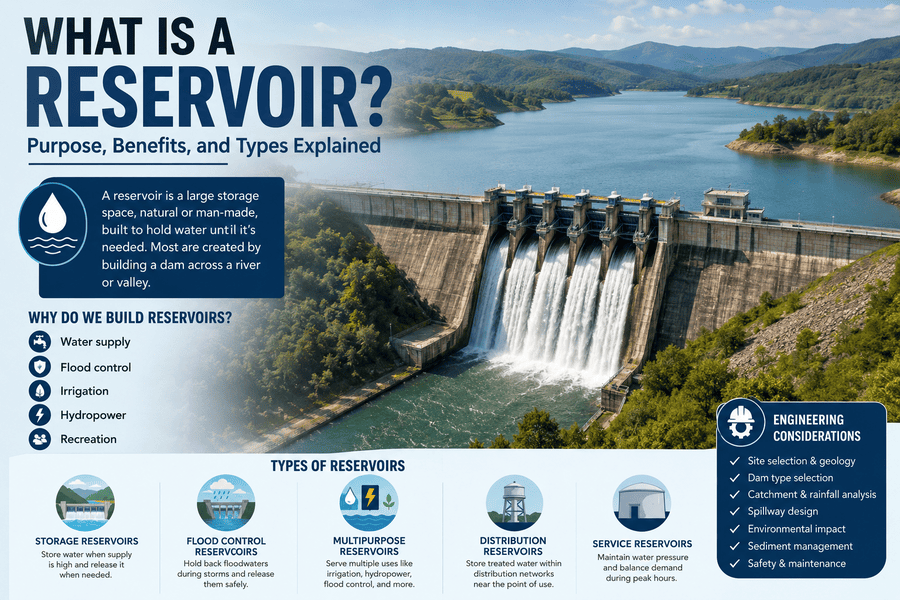
Put simply, it’s a large storage space, either man-made or natural, built to hold water until it’s needed. Most of the time, it’s created by building a dam across a river or a valley. Once the dam is in place, it blocks the natural flow, and water starts collecting behind it until you get a large body of water.
You do get natural reservoirs too, like certain lakes, but when people talk about “water reservoirs” in an engineering context, they’re almost always talking about the man-made kind.
At its core, a reservoir is really just a control mechanism. Store water when there’s plenty. Release it when there isn’t.
Why Do We Even Build Reservoirs?
They’re not there just to look nice on a map. A reservoir usually earns its place for one, or several, of these reasons:
- Water supply – Towns and cities need water even during dry months, and reservoirs are what make that possible. They store water in the wet season and release it slowly when rainfall drops off.
- Flood control – Heavy rain can overwhelm a river fast. Reservoirs act like a buffer, holding back the surge so it doesn’t flood everything downstream.
- Irrigation – Farmers depend heavily on reservoirs, especially in areas where rainfall isn’t reliable year-round.
- Hydropower – Water released through turbines can generate electricity, which is why you’ll often see a power plant sitting right next to a dam.
- Recreation – Not the main purpose, but a nice side effect. Boating, fishing, and camping spots often pop up around large reservoirs, which brings in tourism dollars too.
What Benefits Do Water Reservoirs Actually Bring?
It’s easy to think of reservoirs as just “water storage,” but the impact goes further than that.
A few of the bigger benefits:
- Steady drinking water supply, even through dry spells
- Lower flood risk for towns downstream
- Water for factories and industrial processes
- A habitat that supports fish and other aquatic life
- Clean, renewable electricity via hydropower
- Recharging groundwater in the surrounding area
- A buffer against drought for farming regions
There’s also the long game to consider. A reservoir built and maintained properly can serve a region for generations. Some dams still in use today are over a hundred years old. That’s a pretty solid return on infrastructure investment, honestly.
Types of Reservoirs
Not every reservoir is built for the same job, and the design changes depending on what it’s meant to do.
1. Storage reservoirs
The most common type reservoir by far. They collect water when supply is high and release it gradually when it’s needed, mainly for domestic supply, irrigation, and power generation.
2. Flood control reservoirs
Flood control reservoirs are built specifically to soak up excess water during storms and release it in a controlled way afterward, so nothing downstream gets overwhelmed.
3. Multipurpose reservoirs
This is where one reservoir does several jobs at once, maybe irrigation, hydropower, flood control, and drinking water supply, all from the same structure. Most large modern dam projects lean this way because it makes better use of the investment.
4. Distribution reservoirs
Smaller and closer to home, quite literally. These sit within city water networks and store treated water near the point of use, which helps balance out demand across the day.
5. Service reservoirs
Common in municipal systems, these keep water pressure steady, particularly during peak usage hours like early morning or evening.
The Engineering Side of Things
For anyone studying civil engineering, reservoir design is one of those topics that comes up again and again. There’s a lot to weigh up before construction even starts:
- Site selection and how stable the geology is
- Which dam type makes sense (embankment, gravity, arch)
- Catchment area size and rainfall patterns
- Spillway design, so excess water has somewhere safe to go
- Impact on the surrounding environment and ecosystems
Get any of this wrong and the consequences aren’t small. Sediment can build up over time, storage capacity drops, and in the worst cases, you’re looking at structural failure. That’s exactly why reservoir engineering stays such a heavily studied and closely regulated field.
Conclusion
Reservoirs don’t get much attention day to day, but they’re doing more than most people realize. The water from your tap, the electricity in your home, sometimes both trace back to a reservoir somewhere along the line.
Big multipurpose dam or small local distribution reservoir, the underlying idea is the same either way: hold water when it’s available, let it go when it’s needed. For anyone in construction or civil engineering, it’s a solid example of how infrastructure decisions end up shaping everyday life, especially when the dry season rolls around.