
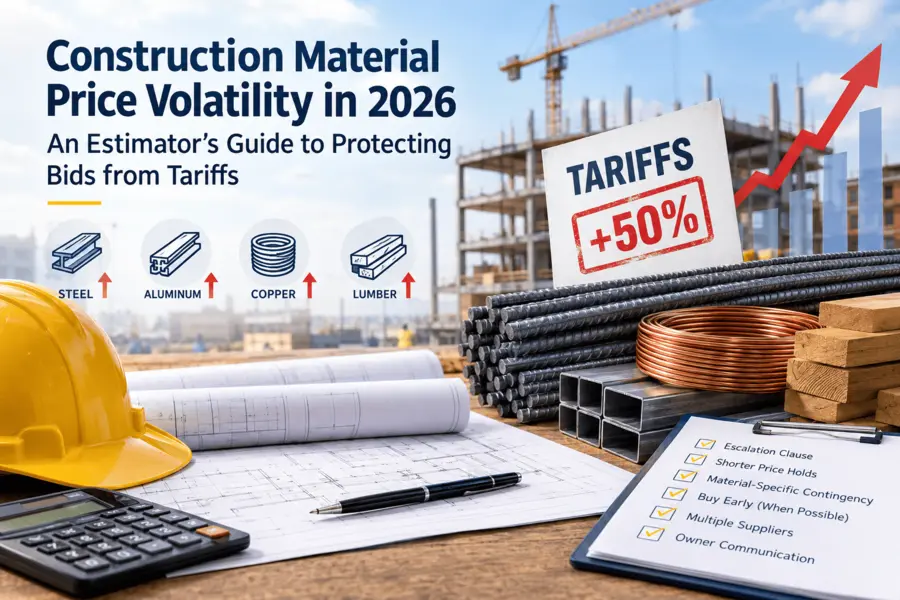
Construction Material Price Volatility in 2026: An Estimator’s Guide to Protecting Bids from Tariffs
Picture this. You spent two weeks on a bid. You checked every steel quantity twice, worked through the bar bending schedule, got three supplier quotes, and came in at a number you trusted. You won the job.
Then the purchase order goes out four months later, and the steel price has jumped. Not by a little. The margin you were counting on is gone, and you’re the one explaining it to your boss.
If you estimate construction work in the US right now, you’ve probably lived some version of that story. Construction material price volatility has become the problem nobody can ignore in 2026, and tariffs are a big reason why. Steel, aluminum, and copper products were hit with a 50% tariff as of April 2026. The Producer Price Index for construction materials reached a record high in March, up 6% from a year earlier. And the rules keep changing, which may be worse than the high prices themselves.
So what can you actually do about it? Quite a bit, it turns out. But first, it helps to understand why tariffs hurt estimates so much.
Why Tariffs Hit Estimators Harder Than Anyone
A lot of people assume tariffs only affect imported materials. That’s not how it works in practice. When imported steel gets more expensive, domestic mills usually raise their prices too. Why wouldn’t they? So even if your project specs American-made steel, you’re still paying more.
The real trouble, though, is timing.
You price the job on bid day. But you don’t buy the materials on bid day. The owner might take six weeks to award. Then there’s contract paperwork, submittals, approvals. Long-lead items like switchgear and transformers often get priced when they ship, not when you order them. Every one of those delays is a window where prices can move against you.
On steel-heavy jobs, tariff-sensitive materials can easily make up a double-digit share of the budget. A 10 to 15% swing in metal prices can shift the whole project cost by several points. For a lot of contractors, that’s more than the entire fee.
It’s also not one price moving. Lumber does its own thing, which matters a lot on wood-framed jobs where floor joists and framing make up a big part of the material list. Copper does its own thing. Electrical gear has its own lead times and its own price jumps. Putting one flat escalation number across the whole estimate just doesn’t match what’s happening anymore.
8 Ways to Protect Your Bids from Material Price Swings
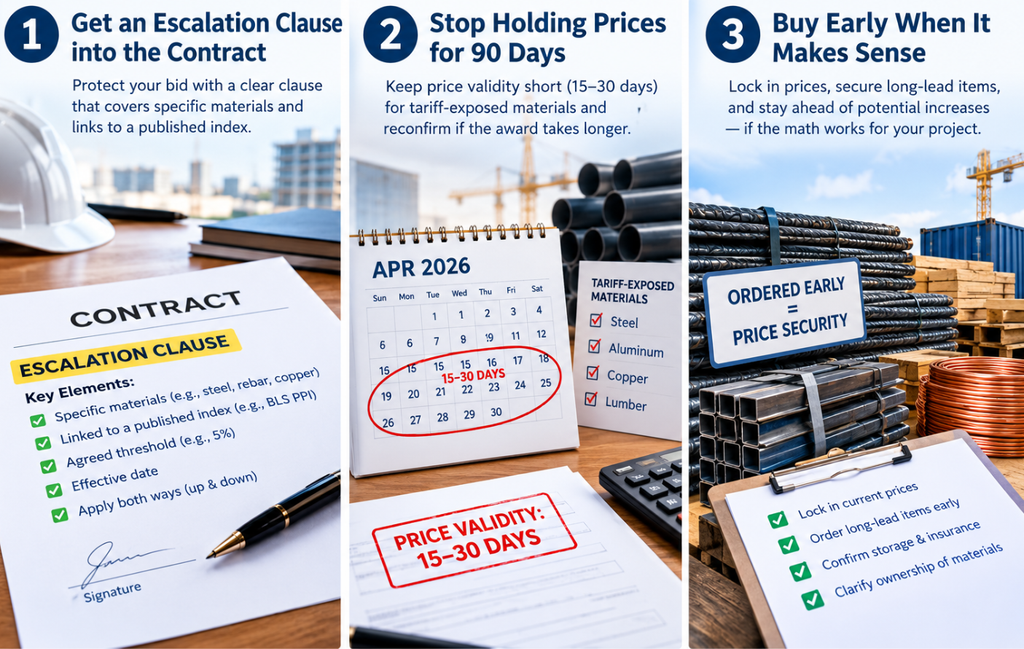
1. Get an Escalation Clause into the Contract
If you only do one thing on this list, do this. An escalation clause lets you adjust the price when certain materials go up past an agreed point.
The good ones are specific. They name exactly which materials are covered, like structural steel, rebar, or copper wire. They tie price changes to a published index, usually the Bureau of Labor Statistics PPI for that material, so nobody’s arguing over whose numbers are right. They set a starting date and a trigger, say any increase over 5%.
One tip that makes owners much more willing to sign: make it work both ways. If prices drop, the owner gets a credit. It’s hard to argue a clause is unfair when it protects both sides.
Material price escalation is only part of the challenge. The ongoing construction labor shortage can also increase project costs as contractors compete for skilled workers. When preparing your estimates, account for both material price fluctuations and labor cost increases to reduce the risk of unexpected budget overruns.
The ConsensusDocs price-impacted materials amendment is a decent place to start. Either way, have a construction attorney look it over before you use it.
2. Stop Holding Prices for 90 Days
Holding a price for three months on tariff-exposed materials is basically betting your margin on the market staying calm. It won’t.
Keep validity on those items to 15 or 30 days, and say clearly in your bid that pricing gets re-confirmed if the award takes longer. Also, check your supplier quotes. If their price expires in 10 days and yours is good for 60, you’re carrying 50 days of risk for free.
3. Put Contingency Where the Risk Actually Is
A flat 5% contingency on everything sounds safe. It isn’t. It’s too thin on your steel and electrical gear, and it’s padding on stable stuff like drywall, which can make you lose the bid on price.
A better approach is to sort your materials by how exposed they are to tariffs. Heavy contingency goes on the high-risk items. Little or none goes on the rest. Write down why you did it that way, because a good owner will ask, and having a clear answer builds trust.
Write down why you did it that way, because a good owner will ask, and having a clear answer builds trust. If you need a starting point for separating material costs, our concrete and steel cost estimation worksheet guide shows how to break quantities and pricing into clear line items.
4. Buy Early When It Makes Sense
If you can see a price increase coming, sometimes the smartest move is to buy before it hits. That might mean ordering tariff-sensitive materials right after award, getting a supplier to lock in a price for a set period, or placing long-lead orders as soon as you can.
Some owners will even pay for early material purchases if you explain the savings. Just make sure storage, insurance, and who owns the materials are spelled out in writing.
Early buying isn’t free, though. You’re tying up cash, paying for storage, and taking on the risk of theft or damage. Run the math before you commit.
5. Don’t Put All Your Eggs with One Supplier
If one supplier gets hit with a new tariff and they’re your only source, you’re stuck with whatever price they give you.
Build relationships with a few suppliers, including domestic ones, and ask where their materials actually come from. Tariffs now vary by product and country, so two quotes for the same item can carry very different risk. That’s information worth having before you pick one.
6. Give the Owner Options
Alternates are one of the most underused tools in a tough market. If the design allows, price a version that uses less tariff-exposed material. Maybe that’s concrete or mass timber instead of structural steel, for example swapping steel columns for reinforced concrete ones. Maybe it’s an equipment brand that’s built domestically. Maybe it’s a different finish with steadier pricing.
Owners like having choices, and it shows them you’re looking out for their budget. It also gives you a fallback if prices spike after award.
7. Don’t Trust Last Year’s Numbers
Historical cost data used to be an estimator’s best friend. Right now it can lead you badly wrong. Last year’s unit price for steel or copper might be way off from today’s.
Get fresh written quotes from suppliers before every bid. Keep an eye on the monthly PPI and the cost reports from ABC and AGC. And when prices are jumping around, run a couple of quick “what if” numbers. What happens to your total if steel goes up 10%? What about 20%? Knowing that before you submit makes it a lot easier to decide how much risk you’re willing to carry.
8. Talk to the Owner Early and Honestly
Owners hate surprises. Honestly, so do you. The worst time to bring up tariff risk is after award, when the price has already gone up.
Raise it during budgeting instead. Put a clarification sheet in your bid that lists which materials are tariff-exposed. Explain your escalation clause, your contingency, and how long your price is good for. You might even give the owner a choice: take on some of the escalation risk in exchange for a lower base price.
Most owners respond well to this. It shows you know the market, and it turns price risk into a shared problem instead of a fight down the road.
A Quick Gut Check Before You Hit Submit
Before your next bid goes out, ask yourself a few questions. Do you know every material in this estimate that’s exposed to tariffs? Are your prices from current, written quotes and not last quarter’s spreadsheet? Does your bid validity line up with your suppliers’ quote dates? Is your contingency sitting on the risky items, or just spread evenly? Is there an escalation clause or at least a clear price qualification? Did you flag long-lead items for early buying, and did you write down your tariff assumptions for the owner?
If you can’t say yes to most of those, that bid is carrying more risk than you probably realize.
Common Questions
How do tariffs affect construction costs?
They raise the price of imported materials like steel, aluminum, copper, and lumber. Domestic producers usually follow with their own price increases, so costs go up even on jobs that use mostly American-made materials.
What is a price escalation clause?
It’s a contract term that lets the price change if specific materials rise past an agreed point. Most are tied to a published index so both sides can measure the change the same way.
How much contingency should I carry for price swings?
There’s no magic number. It works better to set it per material based on tariff exposure, with more on steel, copper, and electrical equipment and less on the stable stuff.
Can I pass tariff increases on to the owner?
Only if your contract says you can. Without an escalation clause or a price qualification, a fixed-price contractor usually eats the increase.
The Bottom Line
Tariff-driven price swings aren’t going away soon. They’ve become part of how the US construction market works, at least for now. The estimators who come out ahead won’t be the ones hoping prices calm down. They’ll be the ones who build that uncertainty into every bid, every contract, and every conversation with the owner.
You don’t have to change everything at once. On your next bid, just pick out your tariff-exposed materials, shorten your price holds, and add an escalation clause. Those three small changes can save you from a very expensive surprise. For more practical tools, browse our estimating sheets.
Have you dealt with tariff-driven price swings on a recent bid? Share your experience in the comments, and subscribe to get more practical estimating guides.