
Reinforced Concrete: What It Is and Where It’s Used
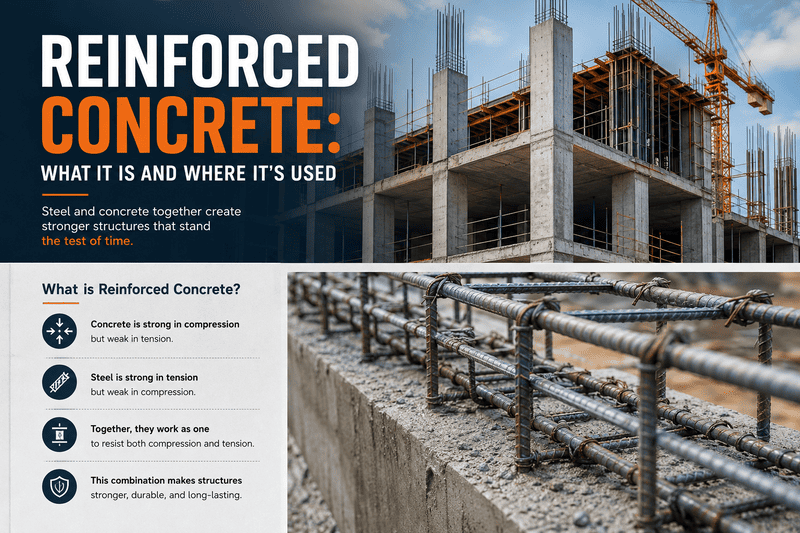
Reinforced concrete is plain concrete with steel bars embedded inside it, and that one addition changes everything about what concrete can do. Plain concrete handles compression well, meaning it’s strong when squeezed, but it’s weak in tension, meaning it cracks easily when pulled or bent. Steel does the opposite. It’s excellent under tension. Put the two together and you get a material that handles both, which is why almost every modern structure, from driveways to skyscrapers, relies on it in some form.
Why Concrete Needs Steel
Picture a concrete beam spanning between two supports. The top of that beam gets compressed under load, and plain concrete handles that fine on its own. But the bottom of the beam stretches, and concrete without reinforcement will crack under that tension fairly quickly, sometimes even under its own weight. Steel rebar placed near the bottom of the beam picks up that tension load, and the concrete around it handles the compression. Neither material could do the job alone nearly as well.
Reinforced Concrete Foundation Work
A reinforced concrete foundation is probably the most common application most people never think about, since it’s buried out of sight from day one. Foundations carry the entire weight of a building down into the soil, and soil rarely behaves in a perfectly even way. Uneven settling puts foundations under bending stress, which plain concrete simply can’t handle over time. Steel reinforcement inside footings and slabs lets the foundation flex slightly and redistribute load without cracking apart, which is exactly what keeps a building’s walls straight for decades instead of years.
Reinforced Concrete Retaining Wall Design
A reinforced concrete retaining wall holds back soil, and soil pushes hard, especially after rain when it gets heavier and more saturated. That pressure creates bending forces along the height of the wall, pushing it to tip or crack outward. Steel reinforcement, usually placed vertically near the inner face of the wall, resists that bending and keeps the wall standing where a plain concrete slab would eventually fail. Drainage behind the wall matters just as much, since trapped water adds pressure that no amount of reinforcement should have to fight alone.
Reinforced Concrete Roof Deck and Driveway Uses
A reinforced concrete roof deck needs to support foot traffic, equipment, water pooling, and sometimes vehicle loads on top of its own weight, all while spanning open space below. Reinforcement mesh or bars distribute that load across the slab and prevent the kind of cracking that eventually leads to leaks. Similarly, a reinforced concrete driveway deals with repeated vehicle weight and constant weather exposure. Plain concrete driveways crack along stress points fairly predictably, while reinforced ones handle that repeated loading far more gracefully, which is why most driveways built to last include at least a basic layer of mesh or rebar.
The Basics of Reinforced Concrete Column Design
Reinforced concrete column design is where the engineering gets genuinely technical, since columns carry compressive load from every floor above them down to the foundation. Vertical rebar inside a column adds tensile strength and helps resist buckling, while horizontal ties, called stirrups, wrap around that vertical steel to stop it from bowing outward under pressure. Get the ratio of steel to concrete wrong, or space the ties too far apart, and a column that looks fine on the surface can fail well before it should under real load. This is one part of construction where following code requirements isn’t optional, since a column failure rarely gives much warning.
Why This Combination Still Wins
Reinforced concrete has been the default choice for well over a century now, and nothing has really displaced it. It’s relatively cheap, the raw materials are available almost everywhere, and once the design gets it right, the resulting structure is durable, fire-resistant, and able to be shaped into almost anything. Steel and concrete simply cover each other’s weaknesses, and that partnership is why so much of the built world, quite literally, is standing on it.