
Types of Bridges: Bridge Types Explained
A bridge carries a road, railway, or footpath over a river, valley, or another road. That’s the basic job. How it does that job changes a lot depending on the span, the load it needs to carry, the ground conditions, and the budget available for the project. This is why so many types of bridges exist, and why picking the right one is a design decision, not a default choice.
This article goes through the main bridge types used today and how each one actually holds itself up.
1. How Bridges Get Classified
There isn’t just one way to sort bridges. Engineers usually group them by:
- Structural form
- Material
- Span length
- Position, meaning fixed or movable
A single bridge often fits more than one group at once. A steel truss bridge, for instance, is a truss by structural form and steel by material. Both labels are correct at the same time.
2. Bridge Types by Structural Form
This is the grouping most people mean when they talk about bridge types, since it describes how the load actually moves through the structure.
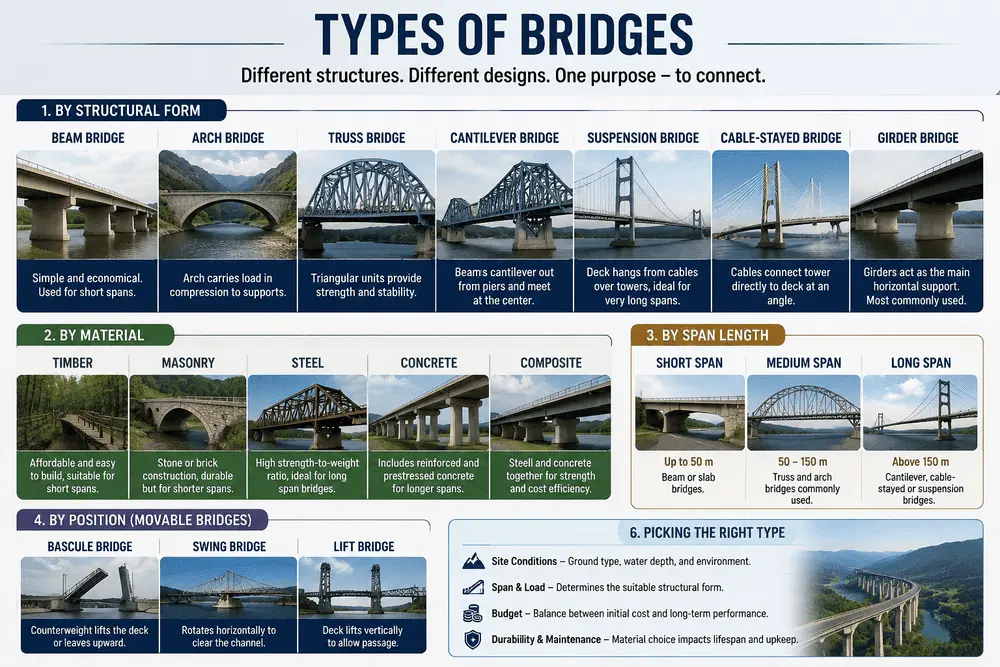
Beam Bridge
The most basic form. A beam sits across two supports, and the load bends the beam before passing into the supports below. Cheap and quick to build, but not suited to long spans.
Arch Bridge
Load moves through the curve of the arch and into the abutments as compression, not bending. Works well where the ground on either side is firm enough to resist the outward thrust.
Truss Bridge
Built from triangular units, usually steel or timber. Triangles don’t distort under load the way squares do, so a truss can span further while using less material than a solid beam.
Cantilever Bridge
Beams project out from piers and meet somewhere near the middle, sometimes with a suspended span bridging the final gap. Nothing needs to support the structure from below while it’s being built or used.
Suspension Bridge
The deck hangs from main cables strung over two towers and anchored into the ground at both ends. This is generally the go-to type for very long crossings, wide rivers, straits, that sort of thing.
Cable-Stayed Bridge
Cables run directly from the tower down to the deck, at an angle, instead of looping over the top like a suspension bridge. Fewer cables are needed overall, and the towers tend to be shorter too.
Girder Bridge
One or more girders act as the main horizontal support, in steel, concrete, or a combination. Probably the most commonly built bridge type in the world just because it’s straightforward and economical.
3. Types of Bridging by Material
Material affects strength, cost, and how much upkeep the structure will need down the line.
Timber
Cheap, easy to work with, fine for short spans or temporary crossings. Not great for durability though, especially with moisture and pests around.
Masonry
Stone or brick, usually built as an arch. Lasts a long time but doesn’t suit long spans well.
Steel
High strength for its weight, which is why it shows up in trusses, suspension bridges, and cable-stayed designs where long spans are the point.
Concrete
Covers both reinforced and prestressed concrete. Prestressing pushes the span further than ordinary reinforced concrete can manage, mainly by cutting down on tension cracking.
Composite
A mix, usually a steel girder carrying a concrete deck. Gets the strength of steel and the cost benefit of concrete in one structure.
4. Bridge Types by Span Length
Span length rules out certain structural forms before design even really starts.
Short span – Roughly under 50 metres. Beam or slab bridges handle this range easily.
Medium span – Around 50 to 150 metres. Truss and arch types are common here.
Long span – Above 150 metres. This is cantilever, cable-stayed, or suspension bridge territory.
5. Bridges by Position
Fixed bridges sit at one constant height and don’t move. Movable bridges are built to open up and let boat traffic through underneath, and they come in a few recognisable forms.
Bascule bridge – A counterweight lifts one or two leaves upward, basically a drawbridge.
Swing bridge – Rotates around a central pier to clear the channel.
Lift bridge – The whole deck rises straight up between two towers.
6. Picking the Right Type
With this many types of bridges to choose from, the decision usually comes down to site conditions, span, expected load, and budget. Short crossings over firm ground tend to go with beam or girder bridges since there’s no reason to overbuild. Wider gaps, rivers, valleys, that kind of terrain, push the design toward arch, cantilever, or suspension forms instead. Material choice follows the same logic, weighing strength against cost and how long the bridge needs to last.
Once these core bridge types make sense, the more advanced designs used in real projects are easier to follow, since most of them are built on these same basic principles.