
Types of Bricks: A Civil Engineering Student’s Guide to Classification and Use
Introduction
Pick the wrong brick and you’ll find out eventually. Frost damage. Sulfate attack. A wall that can’t take the load stacked above it. Bricks aren’t interchangeable, and knowing the types available, what they’re made from, and where each one actually belongs is one of those things every civil engineering student needs early, ideally before it turns into an expensive lesson on site.
How Bricks Get Classified
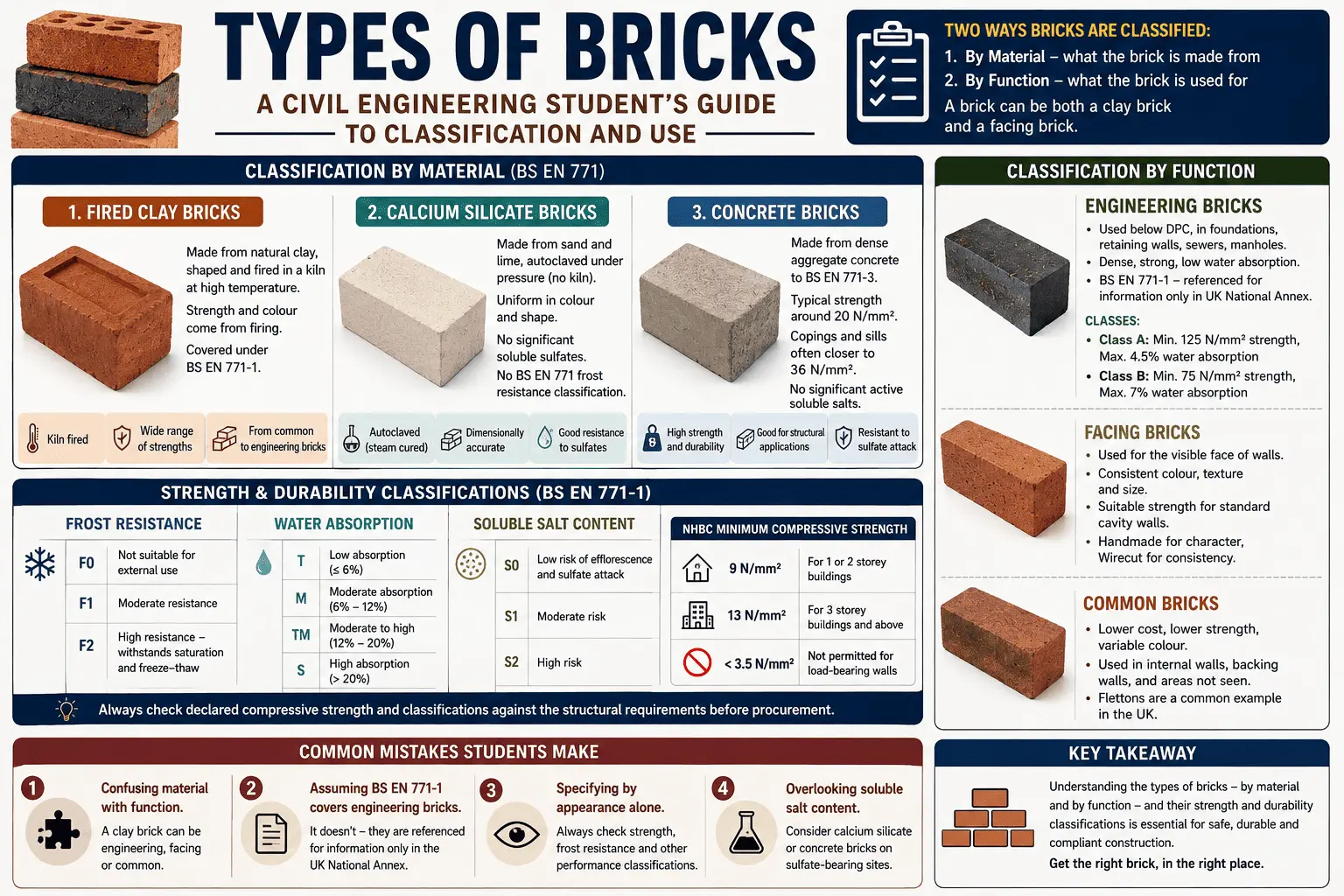
Two systems, and mixing them up trips people up constantly. One sorts by raw material, what the brick is actually made from. The other sorts by function, what job it’s doing once it’s sitting in the wall. A single brick can be fired clay and a facing brick at the same time; the two classifications stack on top of each other rather than competing.
UK brick performance sits under BS EN 771, which replaced the older BS 3921 and BS 187. The standard splits by material: Part 1 for clay units, Part 2 for calcium silicate, Part 3 for concrete. Each part sets out strength, water absorption, and durability requirements that manufacturers are obliged to declare.
Bricks Classification by Material
Fired Clay Bricks
Say the word brick and most people picture this. Clay gets shaped, then fired in a kiln at high temperature, and that firing is where both the strength and the colour come from. Clay units fall under BS EN 771-1, and depending on the clay and how hard it’s fired, the same broad category stretches from soft, patchy common bricks all the way to dense, semi-vitreous engineering bricks.
Calcium Silicate Bricks
These get made differently altogether: sand and lime, autoclaved under pressure, no kiln involved. What you end up with is a uniform pale colour and a shape you can rely on, which matters wherever appearance needs to be predictable rather than characterful. No significant soluble sulfates either, so they hold up well on sulfate-bearing ground where a clay brick might not. One catch worth flagging on a spec sheet: calcium silicate bricks carry no BS EN 771 frost resistance classification, so manufacturer guidance carries more weight here than it would elsewhere.
Concrete Bricks
Cast from dense aggregate concrete under BS EN 771-3. Strength and durability move together here in a fairly direct line: a typical concrete brick sits around 20 N/mm², durable enough for most situations, and copings or sills usually push that closer to 36 N/mm². Same as calcium silicate, no significant active soluble salts, which is one fewer thing to think about on a sulfate-exposed site.
Bricks Classification by Function
Material tells you what the brick is. Function tells you where it goes.
Engineering Bricks
These do the heavy lifting, sometimes literally underground. Dense, strong, barely absorb water, exactly what’s needed below damp proof course level, in retaining walls, manholes, anywhere ground load or moisture never lets up. Here’s the part that catches students out: BS EN 771-1 doesn’t actually include engineering bricks directly. They’re referenced for information only, tucked into the UK National Annex rather than fully specified in the main standard.
Two classes cover the field:
Class A: minimum compressive strength of 125 N/mm2, maximum water absorption of 4.5%
Class B: minimum compressive strength of 75 N/mm2, maximum water absorption of 7%, and the one you’ll actually see specified most often
That classic blue-black colour on older engineering bricks isn’t a dye, it’s vitrification from high-temperature firing. Victorian sewers, bridges, basements: plenty of them are still doing exactly the job they were built for, well over a century on.
Facing Bricks
Facing bricks answer a different question entirely: not how much can it carry, but how does it look. Consistent colour. Consistent texture. Consistent shape. Strength is generally fine for standard cavity wall construction, but nobody’s reaching for a facing brick to carry a transfer beam. You’ll find them on the outer leaf of cavity walls, on garden walls, anywhere the finished appearance is the entire point of the exercise. Handmade suits heritage and high-end work; wirecut suits volume production where clean, consistent edges matter more than character.
Common Bricks
Nobody’s meant to see these. Cheaper clay, less refined, lower compressive strength, colour that’s often patchy at best, and none of it matters once the brick’s rendered over or buried in a backing course where it’ll never be looked at again. Flettons, from the London Brick Company, are the classic UK example, and they’ve been quietly holding up unseen brickwork for the best part of a century.
Strength and Durability Classifications
Material and function aren’t the whole picture. BS EN 771-1 also grades bricks by frost resistance, water absorption, and soluble salt content, and these codes show up constantly on spec sheets and drawings whether you’re ready for them or not.
| Classification | Categories | What It Tells You |
| Frost resistance | F0, F1, F2 | F2 withstands saturation and repeated freeze-thaw; F0 shouldn’t be used externally without full protection |
| Water absorption | T, M, TM, S | Lower absorption generally means better durability in wet or exposed conditions |
| Soluble salt content | S0, S1, S2 | Lower salt content reduces the risk of efflorescence and sulfate attack on mortar |
The NHBC adds its own minimum compressive strength thresholds on top: 9 N/mm2 for one- or two-storey buildings, 13 N/mm2 once you’re at three storeys, and anything under 3.5 N/mm2 ruled out for load-bearing walls, full stop. Check the declared strength against what the structure actually demands, and do it before procurement, not after.
Common Mistakes Students Make
1. Confusing material with function. A brick being clay-fired says nothing about whether it’s engineering, facing, or common. Check both, separately, every time.
2. Assuming BS EN 771-1 covers engineering bricks outright. It doesn’t. They sit in the UK National Annex, referenced rather than fully specified in the main standard.
3. Specifying by appearance alone. A facing brick picked purely for colour can still fail structurally, or in exposed, saturated conditions, if nobody checked the frost resistance and strength classifications first.
4. Overlooking soluble salt content on sulfate-bearing sites. Calcium silicate and concrete bricks carry no significant active soluble salts, which can make them the safer call where ground conditions are already a known risk.
FAQs
What are the main types of bricks used in construction?
Fired clay, calcium silicate, and concrete cover the materials. Engineering, facing, and common cover the function. Most spec decisions need both.
What is the difference between Class A and Class B engineering bricks?
Class A demands a minimum 125 N/mm2 compressive strength and caps water absorption at 4.5%. Class B drops that to 75 N/mm2 and 7%, and it’s the one that actually shows up on most specs.
Which British Standard governs brick classification in the UK?
BS EN 771, split three ways: Part 1 for clay, Part 2 for calcium silicate, Part 3 for concrete. All three replaced older standards, including BS 3921 and BS 187.
Can facing bricks be used for structural work?
Generally not for major loads, no. They’re picked for appearance first. If a wall needs both looks and structural capacity, check the facing brick’s declared compressive strength actually meets the demand before assuming it will.
Why are engineering bricks used below damp proof course level?
Low water absorption plus high compressive strength equals resistance to both moisture ingress and ground load, which is exactly the combination foundations, retaining walls, and anything below DPC actually need.
Do calcium silicate bricks perform differently from clay bricks?
Yes. No significant soluble sulfates, so sulfate-bearing ground is less of a concern. But there’s no BS EN 771 frost resistance classification attached, so lean on manufacturer guidance more than you would with clay.
Conclusion
Bricks split two ways, what they’re made of and what job they’re doing, and mixing the two up is the single most common way students get tripped up. Know your Class A from your Class B. Check the frost, absorption, and salt codes before anything gets specified. None of it looks glamorous on paper, but it’s exactly the kind of detail that separates a wall that lasts a century from one that’s spalling within five winters.